A combined ankle and knee orthosis is an orthopaedic device used when a person requires simultaneous support of several sections of the lower limb: the knee joint, ankle and foot.
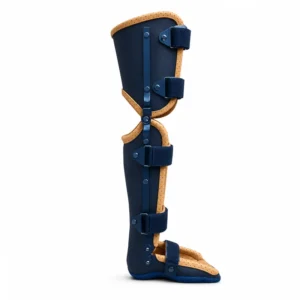
This type of orthosis may be used following complex injuries, surgery, for pronounced leg instability, muscle weakness, gait disorders, neurological conditions and during prolonged rehabilitation.
The combined orthosis helps stabilise the leg, maintain the knee, ankle and foot in a more correct position, improve stability during walking and create safer conditions for recovery.
At our centre you can obtain a combined lower limb orthosis free of charge under the government rehabilitation aid programme. We assist with orthopaedic consultation, device selection and documentation.
This type of orthosis is commonly known by several names:
Indications
A combined ankle and knee orthosis may be prescribed:
After Injuries and Surgery
Instability and Gait Disorders
Neurology and Muscles
Rehabilitation and Prevention
The orthosis helps maintain the lower limb in the correct position, reduce the load on the joints and make movement more stable.
How It Works
The primary purpose of the combined orthosis is to provide simultaneous stabilisation of the knee joint, ankle and foot.
A combined orthosis helps:
stabilise the lower limb;
support the knee joint;
stabilise the ankle and foot;
improve stability during walking;
reduce the load on the joints;
reduce the risk of falls and re-injury;
control the position of the leg;
ease mobility;
make each step safer;
create conditions for recovery of limb function.
Purpose
A combined orthosis is used when support of the knee alone or fixation of the ankle alone is insufficient.
For instance, where a person has knee joint instability, muscle weakness, a gait disorder and incorrect foot position, an ordinary knee brace or ankle support may not deliver the required result. In such cases, an orthosis that simultaneously controls several zones of the leg may be required.
A knee and ankle orthosis helps distribute support across the entire lower limb, improve movement control and make walking more stable.
Indications
A combined lower limb orthosis may be recommended following injuries, surgery, ligament damage, for pronounced joint instability, muscle weakness, neurological conditions, gait disorders and during recovery after prolonged treatment.
This type of orthosis may be especially important when a person has difficulty standing or walking steadily, the leg gives way, the knee is unstable, the foot is poorly controlled or there is a risk of falls.
In such cases, a full leg orthosis helps maintain the correct limb position and improves the safety of movement.
Clinical Cases
Correct Selection
A combined ankle and knee orthosis must be selected individually. It is important to consider the diagnosis, joint condition, foot position, level of muscle strength, gait characteristics and the purpose of using the device.
Selection takes into account:
diagnosis;
cause of instability;
knee joint condition;
ankle joint condition;
foot position;
presence of foot drop;
leg muscle condition;
gait characteristics;
pain level;
presence of injury or surgery;
rehabilitation stage;
patient’s weight;
level of physical activity;
need for movement restriction or control;
physician’s recommendations.
⚠️ An incorrectly selected lower limb orthosis may:
Free of Charge
At our centre you can receive a free orthopaedic consultation.
During the consultation, the specialist will:
Important
Following complex injuries, surgery, neurological disorders or conditions affecting the musculoskeletal system, the lower limb may require enhanced support.
When the knee joint, ankle and foot function unstably, a person may find it difficult to walk safely, maintain balance and control the leg position. This increases the risk of re-injury, falls and joint overloading.
A combined orthosis helps:
Pricing
The cost of a combined orthosis depends on the design complexity, fixation level, materials, fabrication specifics and the patient’s condition.
FAQ
Answers to common questions
A knee orthosis supports only the knee joint. A combined orthosis simultaneously supports the knee joint, ankle and foot. It is used when more comprehensive stabilisation of the entire lower limb is required.
A combined orthosis may be needed for pronounced leg instability, muscle weakness, gait disorders, neurological conditions, following complex injuries, surgery and during prolonged rehabilitation.
Yes, many combined orthoses are designed for walking and everyday activity. The permissible level of activity depends on the diagnosis, device design and specialist’s recommendations.
Yes. A combined orthosis helps stabilise the leg, support the knee, ankle and foot, improve stability and make each step safer.
Yes. Following surgery, a combined orthosis may be used to protect tissues, stabilise joints, control movement and gradually restore leg function.
Yes. For muscle weakness, the orthosis helps compensate for insufficient support, maintain the leg in a more correct position and reduce the risk of instability during walking.
The wearing period depends on the diagnosis, joint condition, degree of muscle weakness, rehabilitation stage and specialist’s recommendations. Some patients need the orthosis only during activity; others require it throughout the entire recovery period.
A correctly selected orthosis stabilises the leg, does not chafe the skin, does not cause numbness, does not restrict blood circulation, does not interfere with permitted activity and helps make walking more stable.
Yes. Where medical indications and the required documents are in place, a combined lower limb orthosis can be obtained free of charge under the government rehabilitation aid programme.