A knee orthosis is an orthopaedic device used to immobilise, stabilise, decompress and support the knee.
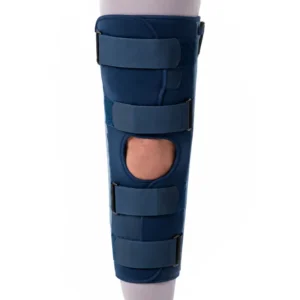
A knee orthosis may be used following injuries, surgery, ligament damage, for knee joint instability, pain during walking, osteoarthritis, joint overloading and during rehabilitation. The device helps reduce the load on the knee, restrict unwanted movements, improve stability during walking and create safer conditions for recovery.
At our centre you can obtain a knee orthosis free of charge under the government rehabilitation aid programme. We assist with orthopaedic consultation, device selection and documentation.
This type of device is commonly known by several names:
Indications
A knee orthosis may be prescribed:
After Injuries and Surgery
Pain and Instability
Rehabilitation and Prevention
The orthosis helps keep the knee joint in the correct position, reduce the load on the affected area and make movement safer.
How It Works
The primary purpose of the orthosis is to provide the knee joint with the required level of support and fixation.
A knee orthosis helps:
stabilise the knee
relieve pain
reduce the load on the joint
restrict movements that impede recovery
improve stability during walking
support correct leg alignment
reduce the risk of re-injury
ease mobility
create conditions for recovery of knee joint function
Types of Orthoses
Knee orthoses differ in design, degree of fixation and purpose. The choice of design depends on the diagnosis, ligament condition, pain level, degree of instability, rehabilitation stage and required movement control.
Our centre provides:
Non-Hinged Orthosis
Support without a hinge
Hinged Orthosis
Controlled stabilisation
Comparison
🦵 Non-Hinged Orthosis
Provides knee support and fixation without mechanical hinges. Helps stabilise the joint, reduce the load and make walking more comfortable.
⚙️ Hinged Orthosis
Features special elements that help control knee joint movement. Used when not only knee support is needed but also restriction or guidance of flexion and extension.
The choice between a non-hinged and hinged orthosis depends on joint condition, degree of instability, diagnosis, recovery stage and physician’s recommendations.
Classification
Knee orthoses may provide varying degrees of fixation.
Correct Selection
A knee orthosis must be selected individually. It is important to consider the diagnosis, joint condition, pain level, degree of instability, gait characteristics and the purpose of using the device.
Selection takes into account:
diagnosis;
cause of pain or instability;
ligament condition;
degree of joint damage;
presence of injury or surgery;
rehabilitation stage;
patient’s weight;
level of physical activity;
gait characteristics;
need for movement restriction;
physician’s recommendations;
⚠️ An incorrectly selected knee brace or knee joint support may:
Free of Charge
At our centre you can receive a free orthopaedic consultation.
During the consultation, the specialist will:
Important
After injuries, surgery, ligament damage or conditions, the knee joint often requires additional support.
During walking, the knee is under constant load. If the joint is unstable or damaged tissues continue to be overloaded, pain and discomfort may persist for longer.
A knee orthosis helps:
Pricing
The cost of an orthosis depends on the type of device, fixation level, materials, fabrication complexity and individual patient characteristics.
Approximate pricing for knee orthoses
Free of Charge
Our centre offers free provision of a knee orthosis under the government rehabilitation aid programme.
FAQ
Answers to common questions
A knee brace most commonly provides compression and light support. An orthosis offers more pronounced fixation, can restrict specific movements and support the knee joint in the correct position. In everyday use, these terms frequently overlap — people may search for a knee orthosis, knee brace, knee stabiliser or orthopaedic knee pad, all meaning a device for joint support and stabilisation.
A knee orthosis may be needed after injuries, surgery, ligament damage, for knee instability, pain during walking, osteoarthritis and during rehabilitation.
A non-hinged orthosis provides knee support and fixation without a mechanical hinge. A hinged orthosis features special elements that help control joint movement and provide more pronounced stabilisation. It is often used for instability, after ligament injuries and surgery.
Yes, many knee orthoses are designed for walking and everyday activity. The permissible level of activity depends on the diagnosis, device design and specialist’s recommendations.
Yes. After surgery, an orthosis may be used to protect tissues, stabilise the joint, restrict movement and gradually restore knee function.
The wearing period depends on the diagnosis, injury, surgery, pain level and rehabilitation stage. Some patients need the orthosis only during activity; others require it throughout the entire recovery period.
A correctly fitted orthosis stabilises the knee joint, does not chafe the skin, does not cause numbness, does not restrict blood circulation, does not interfere with permitted activity and helps reduce the feeling of instability.
Yes. Where medical indications and the required documents are in place, a knee orthosis can be obtained free of charge under the government rehabilitation aid programme.