Bionic Arm — How to Get One for Free in Ukraine!
Price, technologies, capabilities and full restoration of functions
Our centers are located in Kyiv, Odesa and Rivne. We accept patients from all over Ukraine and provide comfortable conditions throughout the entire prosthetics period.
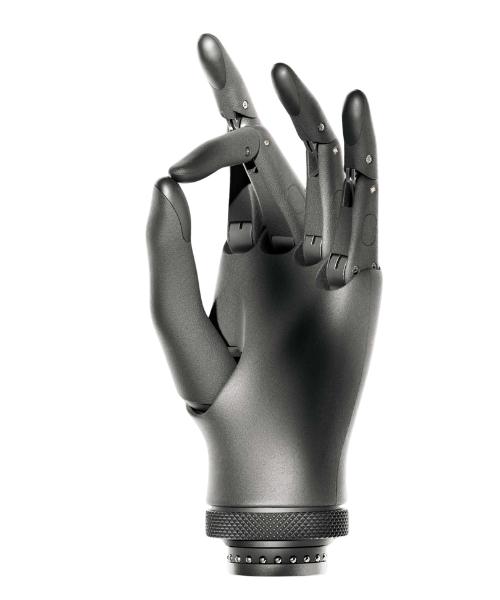
A bionic arm is a high-tech next-generation prosthesis that allows a person after amputation to maximally restore the lost functions of the upper limb, regain independence, the ability to self-care and their usual quality of life.
Unlike conventional solutions, a bionic arm prosthesis is not just a mechanical device, but a complex system that combines electronics, sensors, software and elements of artificial intelligence.
Today such devices are also called:
- ◉ robotic arm prosthesis
- ◉ robotic arm
- ◉ cyber arm prosthesis
- ◉ cyber arm
- ◉ electronic arm prosthesis
- ◉ smart arm prosthesis
- ◉ neuroprosthetic arm
All these terms describe the same class of technology — bionic prostheses that come as close as possible to the natural functioning of the human arm.
What is a bionic arm prosthesis
A bionic (myoelectric) arm prosthesis is a device controlled by the electrical signals of a person’s muscles.
Even after amputation, the nervous system continues to function: the brain sends commands to move the arm, and these signals are preserved in the muscles of the residual limb.
How this is used:
- ◉ special sensors detect the electrical activity of muscles (EMG)
- ◉ signals are transmitted to the microprocessor
- ◉ the system interprets the user’s intention
- ◉ a movement command is formed
- ◉ the prosthesis performs the action
Thus, the myoelectric arm prosthesis allows movement to be controlled almost intuitively, without complex mechanical effort.
How a robotic arm prosthesis works
A modern robotic arm is a comprehensive engineering system.
It consists of several interconnected components, each performing its own function.
Main structural elements:
1. Sensor system
Reads muscle signals and transmits them to the control system. The more sensors — the more precise the control.
2. Microprocessor
Processes signals, recognizes the type of movement and generates commands for the actuating mechanisms.
3. Actuators and mechanics
Responsible for finger and wrist movement, rotation and grip strength.
4. Software
Controls the system’s operation, allows the prosthesis to be configured and adapted to the user.
Smart arm prosthesis — artificial intelligence technologies
Modern cyber arm prostheses use AI technologies.
This fundamentally changes the level of control.
What artificial intelligence adds:
- ◉ analysis of complex signal combinations
- ◉ recognition of user intentions
- ◉ adaptation to behavior
- ◉ automatic adjustment
- ◉ reduction in error rate
Such a smart arm prosthesis does not just respond to commands — it learns and becomes more precise over time.
Next-generation bionic hand — Esper Hand
One of the most advanced solutions in bionic prosthetics is the Esper Hand.
This is no longer just a bionic hand prosthesis — it is an intelligent movement control system.
Technologies used in Esper Hand
- ◉ over 20 sensors for signal detection
- ◉ Pattern Recognition system
- ◉ machine learning algorithms
- ◉ real-time signal analysis
- ◉ prediction of user actions
How it works in practice
Unlike conventional prostheses:
- ◉ not a single signal but the full set of muscle activity is analyzed
- ◉ the system understands which movement the person wants to perform
- ◉ the grip type is selected automatically
- ◉ movement force and speed are adjusted accordingly
👉 As a result, the cyber arm becomes as natural to use as possible.
Self-learning and adaptation
The system gradually:
- ◉ memorizes repetitive actions
- ◉ improves movement precision
- ◉ optimizes grip strength
- ◉ speeds up task execution
👉 This makes the high-tech arm prosthesis truly individual for each user.
This makes the high-tech arm prosthesis truly individual for each user.
Functional capabilities of the bionic arm
A modern functional arm prosthesis allows a wide range of tasks to be performed.
- ◉ holding objects
- ◉ carrying items
- ◉ stabilizing objects
- ◉ using a smartphone
- ◉ typing
- ◉ writing
- ◉ getting dressed
- ◉ cooking
- ◉ working with small objects
- ◉ manipulating tools
- ◉ performing professional tasks
Grip types
The bionic arm supports different modes:
Cylindrical
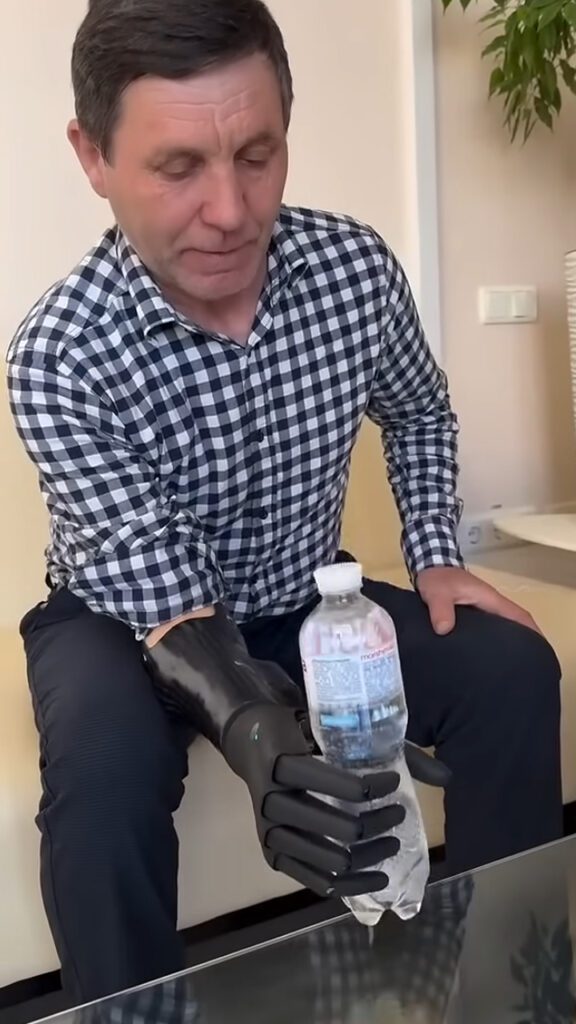
bottles, glasses
Precision
delicate actions
Switching can occur automatically or via muscle signals.
Differences from mechanical prostheses
- ◉ operated via cable systems
- ◉ limited functionality
- ◉ require physical effort
- ◉ less precise
- ◉ controlled by muscles
- ◉ provide precise movements
- ◉ look natural
- ◉ adapt to the user
A neuroprosthetic arm represents the next level of technological advancement.
Bionic arm — price in Ukraine
The price of a bionic arm is determined individually and depends on several key factors: amputation level, structural complexity, functional capabilities, number of sensors and technologies used.
Basic myoelectric models belong to the more affordable segment and are suitable for performing basic everyday actions. Approximate cost — from 250,000 to 600,000 UAH.
More advanced solutions are robotic and intelligent arm prostheses with extended functionality, enhanced movement precision and adaptive control. Approximate cost — from 600,000 to 2,500,000 UAH and above.
The total cost includes not only the device itself but the full scope of work:
- ◉ initial consultation and diagnostics
- ◉ selection of the appropriate technology
- ◉ fabrication of an individual socket
- ◉ programming and configuration of the control system
- ◉ user training
- ◉ rehabilitation course
- ◉ ongoing support
If there are medical indications and an approved individual rehabilitation program (IRP), prosthetics costs may be reimbursed by the state.
Free bionic arm prosthetics in Ukraine
Ukraine has a state program that allows obtaining a bionic arm prosthesis free of charge when the established requirements are met.
It is implemented on the basis of Cabinet of Ministers of Ukraine Resolution No. 321 and provides patients with modern rehabilitation aids when there are medical indications.
The “All-Ukrainian Rehabilitation and Prosthetics Center ‘ZDOROVYE'” participates in this program and takes on the entire process — from document preparation to the patient’s full adaptation to the prosthesis.
What is included in free prosthetics
The patient receives not only the prosthesis itself but also the full range of services required to restore arm function:
- ◉ fabrication of a bionic or myoelectric prosthesis
- ◉ individual fitting of the device
- ◉ sensor and control system configuration
- ◉ training in use
- ◉ rehabilitation activities
- ◉ support at every stage
Additionally provided:
- ◉ specialist home visit
- ◉ transfer to the center
- ◉ accommodation and meals during the prosthetics period
- ◉ assistance with collecting and preparing documents
Prosthesis fabrication timeline
The fabrication duration depends on the complexity of the device and the technology selected.
- ◉ standard bionic solutions — up to 20–25 working days
- ◉ more complex systems with extended functionality — up to 30 working days or more
During this time, fittings, adjustments and calibration are carried out to ensure comfort, reliable fit and correct prosthesis performance.
Important information when applying
When submitting documents to social protection authorities, it is necessary to specify in advance the organization that will carry out the prosthetics.
It is important to enter: LLC “All-Ukrainian Rehabilitation and Prosthetics Center ‘ZDOROVYE'”
This is a mandatory condition, as the selected organization is recorded in the referral and determines where the prosthetics will take place.
When can you get a prosthesis for free
The right to free provision arises when supporting documents are in place.
Grounds:
- ◉ established disability or medical indications
- ◉ medical commission conclusion (VKK / MSEK)
- ◉ approved individual rehabilitation program (IRP)
Additionally important to note:
- ◉ the patient independently chooses the center
- ◉ the chosen organization is specified in the referral
- ◉ the state covers costs within the established budget
Who can use the program
The state program covers the following categories of patients:
- ◉ persons with disabilities
- ◉ military personnel and veterans
- ◉ those injured as a result of combat operations
- ◉ patients after upper limb amputation
- ◉ patients with medical indications for prosthetics
Important: rehabilitation for military personnel and veterans is carried out at the Rivne Regional War Veterans Hospital.
How prosthetics works
The process is always individual but includes mandatory stages.
1. Consultation
◉ assessment of the residual limb
◉ muscle activity analysis
◉ determination of amputation level
2. Solution selection
◉ choosing the prosthesis type
◉ determining functionality
◉ accounting for the patient’s needs
3. Fabrication
◉ creating an individual socket
◉ component integration
4. Configuration
◉ sensor calibration
◉ control system setup
◉ system adaptation
5. Training
◉ mastering movements
◉ grip training
◉ skill development
6. Rehabilitation
◉ function restoration
◉ daily living skills training
◉ building confidence
7. Service and support:
- ◉ technical maintenance
- ◉ adjustment
- ◉ repair
- ◉ system updates
Adapting to the bionic arm
The adaptation process takes time and proceeds in stages.
- ◉ first skills — 1–2 weeks
- ◉ basic adaptation — 1–2 months
- ◉ confident use — 3–6 months
What affects adaptation speed
- ◉ amputation level
- ◉ muscle condition
- ◉ prosthesis type
- ◉ regularity of training
- ◉ patient motivation
Possible difficulties and their solutions
During use, the following may occur:
- ◉ socket chafing
- ◉ muscle fatigue
- ◉ control errors
- ◉ phantom pain
How problems are resolved:
- ◉ socket adjustment
- ◉ system reconfiguration
- ◉ additional training
- ◉ work with a rehabilitation specialist
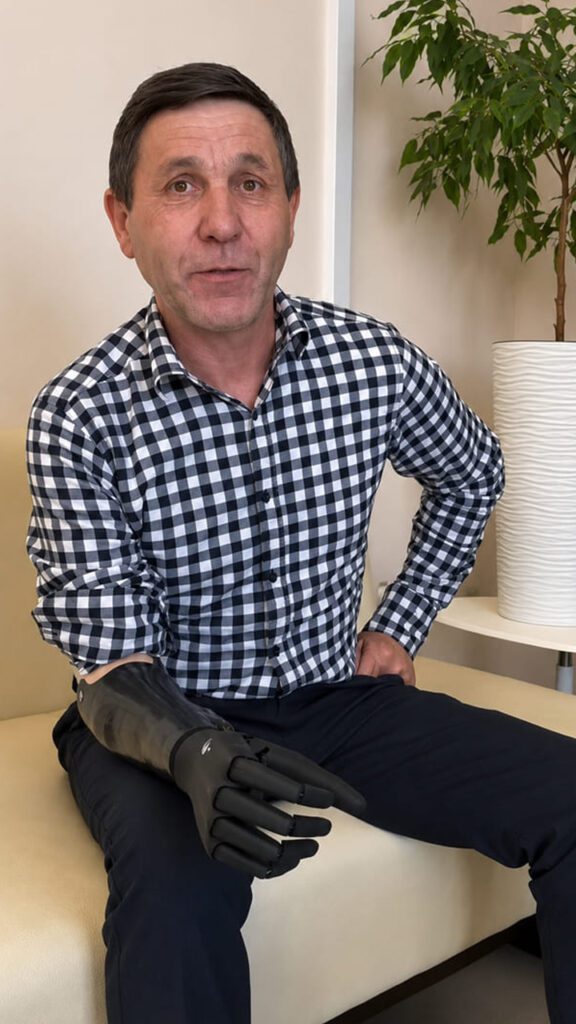
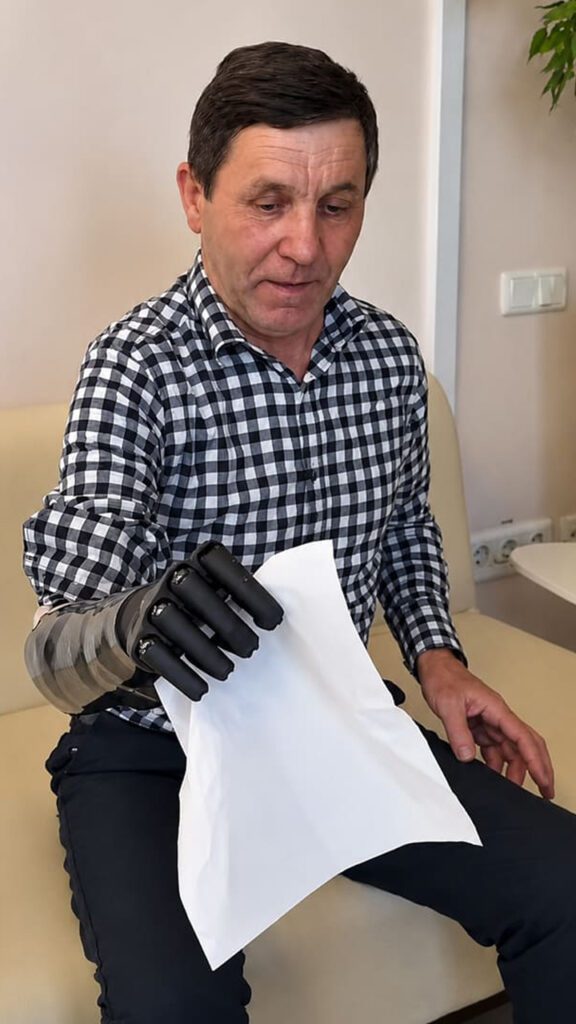
Andriy — a military serviceman who received a bionic arm prosthesis
If you want to get a bionic arm prosthesis — start with a professional consultation from a specialist.
👉 Submit a request and get a specialist consultation