Lower limb orthoses are orthopedic devices used for fixation, stabilization, offloading and support of the leg joints.
A leg orthosis can be used for injuries, joint conditions, instability, gait disorders, muscle weakness, after surgery and during rehabilitation. These devices help reduce pain, improve walking stability, restrict unwanted movements and create safer conditions for recovery.
An orthosis supports:
At our centre, lower limb orthoses are available free of charge under the state rehabilitation programme. We assist with orthopaedic consultations, device selection and paperwork.
Indications
Lower limb orthoses may be prescribed:
Injuries and fractures
Pain and instability
Neurological conditions
Post-surgery and rehabilitation
An orthosis helps keep the leg in the correct position, reduce load on the injured area and improve movement safety.
How it works
The primary purpose of an orthosis is to provide support to the joint or segment of the leg that requires fixation, stabilization or offloading. Orthoses help to:
stabilize the joint
reduce pain
reduce load on the knee, ankle or foot
restrict movements that impede recovery
improve walking stability
maintain correct leg alignment
reduce the risk of re-injury
ease mobility
create conditions for restoring limb function
What we make
Our centre fabricates lower limb orthoses for fixation, stabilization and support of leg joints. Orthoses can be used after injuries, surgery, for ligament damage, joint instability, gait disorders, muscle weakness and during recovery.
Types by design
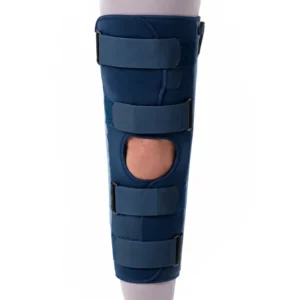
A knee joint orthosis is used for fixation, stabilization and offloading of the knee.
In everyday use and search queries, a knee joint orthosis is often referred to as:
These terms are often used interchangeably when referring to devices for knee support, fixation and stabilization. An orthosis helps reduce load on the knee joint, improve stability and make movement safer.
Types by design
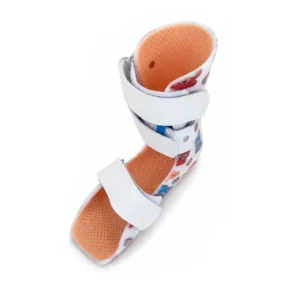
An ankle and foot orthosis is used for foot support, ankle stabilization and improving walking safety. It helps keep the foot and ankle in the correct position, reduces joint load and makes movement more stable.
This type of orthosis may be prescribed:
Special type
Simultaneous support for multiple segments of the lower limb
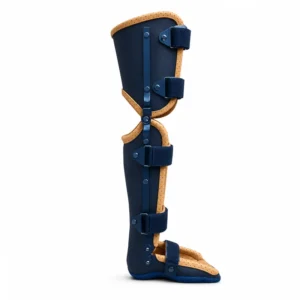
A combined orthosis is used when simultaneous support of the knee joint, ankle and foot is required.
This orthosis may be recommended:
A combined orthosis helps stabilize the leg, improve walking stability and create safer conditions for recovery.
Classification
Correct choice
A lower limb orthosis must be selected individually. The diagnosis, joint condition, activity level, gait characteristics and intended use of the device all need to be taken into account.
Factors considered during selection:
diagnosis;
injury zone;
pain level;
degree of joint instability;
muscle condition;
gait characteristics;
patient weight;
level of physical activity;
rehabilitation stage;
need for leg position correction;
physician recommendations;
⚠️ An incorrectly fitted orthosis may:
Free of charge
At our centre you can receive a free orthopaedic consultation.
During the consultation the specialist will:
Important
After injuries, surgery, joint conditions or neurological disorders, the lower limb often needs additional support. During walking, the knee joint, ankle and foot are under constant load. If the joint is unstable or damaged tissues continue to be overloaded, pain and discomfort may persist longer.
Pricing
The cost of an orthosis depends on the device type, fixation level, materials, fabrication complexity and individual patient characteristics.
Approximate cost of lower limb orthoses
Free of charge
At our centre it is possible to receive lower limb orthoses free of charge under the state rehabilitation device programme.
FAQ
Answers to common questions
A brace typically provides compression and mild support. An orthosis offers more pronounced fixation, can restrict specific movements and holds the joint or limb in the correct position. In everyday use the terms often overlap. For example, a knee joint orthosis is frequently referred to as a knee brace, knee support or knee stabilizer.
In everyday speech and search queries these terms are often used interchangeably. People may search for “knee orthosis,” “knee brace,” “knee support” or “knee stabilizer,” all referring to a device for knee support and fixation. The exact design is selected after consultation: it may be non-hinged, hinged, soft, semi-rigid or reinforced.
A knee joint orthosis may be needed after injuries, surgery, ligament damage, for knee instability, pain while walking, arthrosis and during rehabilitation.
A non-hinged orthosis provides knee support and fixation without a mechanical hinge. A hinged orthosis has special elements that help control joint movement and provide more pronounced stabilization. It is often used for instability, after ligament injuries and surgery.
An ankle and foot orthosis may be used after injuries, sprains, ligament damage, fractures, surgery, for joint instability, foot drop, gait disorders and muscle weakness.
A non-hinged orthosis fixes the foot and ankle in the required position. A hinged orthosis allows controlled movement while supporting the joint. This option may be used for gait disorders, after injuries, surgery and for neurological conditions.
A combined orthosis is prescribed when simultaneous support of several leg segments is needed: the knee joint, ankle and foot. It may be used for severe instability, muscle weakness, complex injuries, neurological disorders and gait disorders.
Yes, many lower limb orthoses are designed for walking and daily activities. Whether weight-bearing is permitted depends on the diagnosis, device design and specialist recommendations.
Yes. For foot drop, an orthosis helps keep the foot in a more correct position and makes each step safer. These devices are often used for neurological disorders and muscle weakness.
Yes. After surgery, an orthosis can be used to protect tissues, stabilize the joint, restrict movement and gradually restore leg function.
The wearing period depends on the diagnosis, injury, surgery, pain level and rehabilitation stage. Some patients need an orthosis only during activity, while others require it throughout the entire recovery period.
A correctly fitted orthosis stabilizes the joint, does not irritate the skin, does not cause numbness, does not impair circulation, does not interfere with permitted activity and helps reduce the feeling of instability.
Yes, with the appropriate medical indications and required documents, a leg orthosis can be obtained free of charge under the state rehabilitation device programme.
You are welcome to contact our centre, receive a free orthopaedic consultation, select the appropriate orthosis and get assistance with obtaining the device under the state programme.