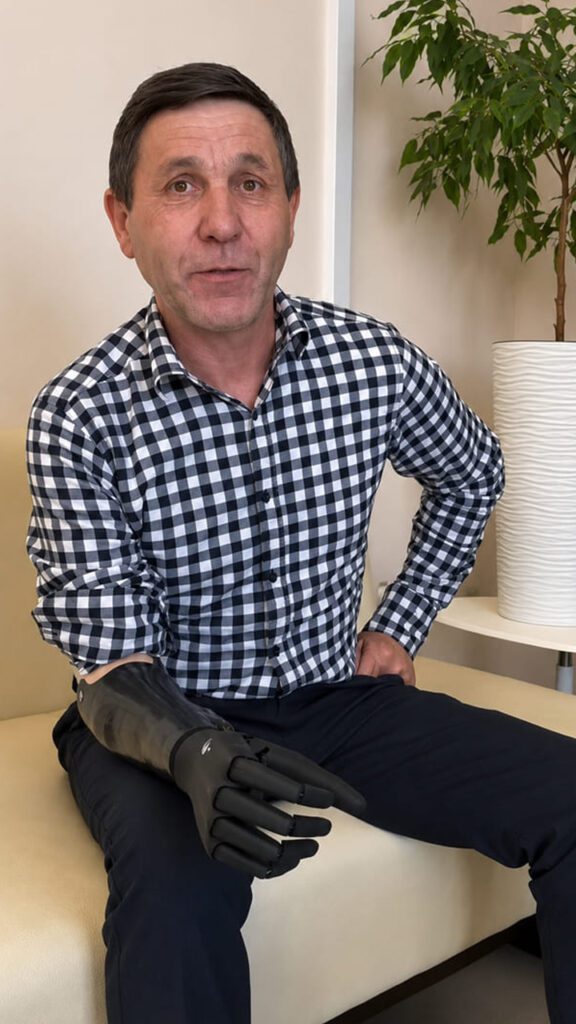
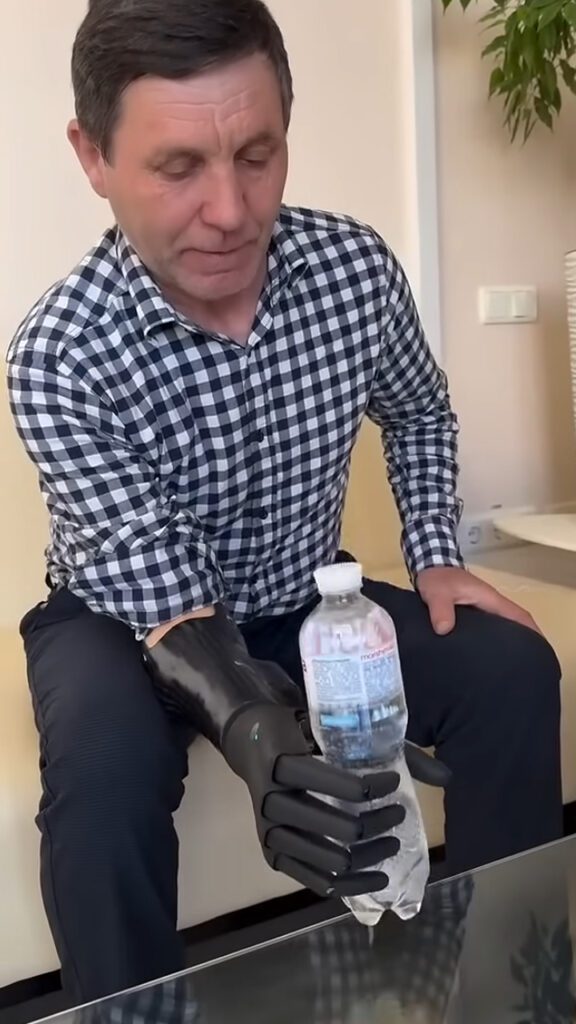
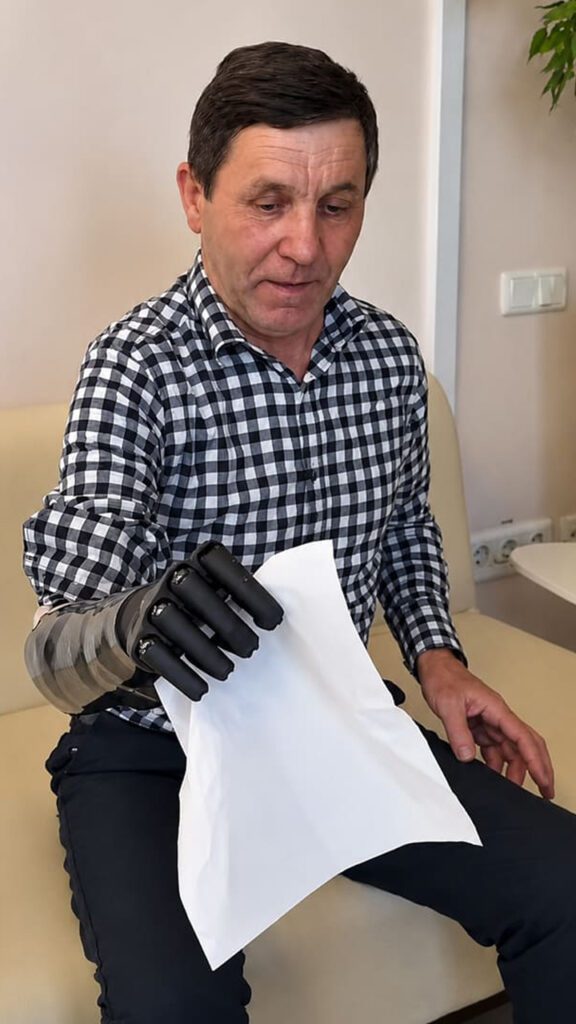
Hand prosthesis

Types and Features

Hand Prosthetics in Ukraine

Modern bionic and mechanical hand prostheses — selection, fabrication, adaptation

Our centers are located in Kyiv, Odesa, and Rivne. We accept patients from all over Ukraine and provide comfortable conditions throughout the entire prosthetics process.

A hand prosthesis is a high-tech solution for patients with hand or finger amputation, enabling them to restore lost hand functions, regain control over movements, and increase independence in everyday life.

Hand prosthetics is one of the most functionally significant areas of upper limb prosthetics, as the hand is responsible for precise movements, gripping objects, and performing most household and work-related tasks.

In Ukraine, modern technologies are applied — from simple mechanical and cosmetic solutions to bionic prostheses controlled via muscle signals (EMG).

We support the patient at every stage — from the initial consultation and solution selection to prosthesis training, adaptation, and ongoing maintenance.

When Is Hand Prosthetics Recommended

Hand prosthetics is recommended for patients with:

  • full or partial hand amputation
  • loss of one or more fingers
  • traumatic injuries (road accidents, workplace injuries, household injuries)
  • consequences of combat operations and mine-blast injuries
  • congenital hand development anomalies
  • severe medical conditions (oncology, vascular pathologies)
  • inability to restore hand function through surgical methods

A hand prosthesis is selected individually — taking into account the amputation level, residual limb condition, and the patient’s needs.


Amputation Levels in Hand Prosthetics

The type of prosthesis directly depends on the level of amputation.

Main options:

  • wrist-level hand amputation
  • partial hand amputation
  • finger amputation
  • combined hand defects

The more anatomical structures preserved, the higher the functionality of the future prosthesis and the precision of movements.

Features of Hand Prosthetics

A hand prosthesis is one of the most complex in terms of functional implementation, as it must replicate fine motor skills.

Key features:

  • the need to precisely replicate finger movements
  • working with different grip types (pinch, cylindrical, etc.)
  • high dependence on residual limb muscle activity
  • individual control configuration
  • the need for extended training
  • heightened requirements for socket fitting accuracy

Unlike a forearm or upper arm prosthesis, here the key role is played not by strength, but by precision and movement control.


How a Hand Prosthesis Works

Mechanical Hand Prostheses

Mechanical prostheses operate through the movement of the remaining part of the arm or the body.

Features:

  • hand opening and closing via a cable system
  • basic functionality
  • high reliability
  • ease of use
  • no electronics required

These prostheses are suitable for simple tasks and are used when precision requirements are low.

Bionic Hand Prostheses (Myoelectric)

Bionic prostheses are controlled by muscle signals.

Operating principle:

  • sensors detect electrical muscle signals
  • the signal is processed by the control system
  • the prosthesis performs the desired movement


Capabilities:

  • multiple grip types
  • precise object holding
  • working with small objects
  • using a smartphone
  • performing complex household and professional tasks

Types of Hand Prostheses

1. Cosmetic (Passive)

Used to restore appearance.

Features:

  • realistic appearance
  • no active movements
  • psychological comfort
  • restoration of body symmetry

2. Mechanical Hand Prostheses

Functional solutions for basic tasks.

Features:

  • simple design
  • limited functionality
  • high reliability
  • no electronics required

3. Bionic (Myoelectric) Hand Prostheses

The most technologically advanced option.

Features:

  • muscle signal control
  • high movement precision
  • multiple grip modes
  • user-specific adaptation
  • ability to perform complex actions

Adapting to a Hand Prosthesis

The adaptation process is gradual:

  • first skills — 1–2 weeks
  • basic adaptation — 2–6 weeks
  • confident use — 1–3 months


Timelines depend on:

  • amputation level
  • prosthesis type
  • regularity of training
  • muscle condition

What You Can Do with a Hand Prosthesis

After adaptation, the patient can:

  • hold and carry objects
  • use a phone
  • type and write
  • dress independently
  • cook
  • perform household tasks
  • work

Bionic prostheses allow for more precise and complex actions.

What to Keep in Mind

Hand prosthetics has its own specifics:

  • regular practice is required
  • precise movements are mastered gradually
  • prosthesis configuration is necessary
  • bionic models require charging
  • periodic adjustment of the control system is needed

Possible Challenges and Solutions

During use, the following may occur:

  • socket chafing
  • muscle fatigue
  • control difficulties
  • phantom pain


Solutions:

  • socket fit adjustment
  • prosthesis reconfiguration
  • working with a rehabilitation specialist

The Impact of Residual Limb Condition

The residual limb condition affects:

  • wearing comfort
  • control precision
  • adaptation speed


Key factors:

  • residual limb shape
  • length
  • skin condition
  • muscle activity

A detailed assessment is conducted before prosthetics.

Esper Hand — A Next-Generation Bionic Hand Prosthesis

One of the most technologically advanced solutions on the market is the Esper Hand — a bionic hand prosthesis developed using artificial intelligence and modern signal processing algorithms.

Unlike classic myoelectric prostheses, the Esper Hand does not simply execute commands — it adapts to the user and improves control over time.

How Esper Hand Works

The prosthesis uses EMG signals — electrical impulses from the residual limb muscles.

Control process:

  • sensors read muscle signals
  • the system analyzes and recognizes movement intent
  • the prosthesis performs the corresponding action
  • algorithms adapt to the user

Over time, control becomes more precise and intuitive.
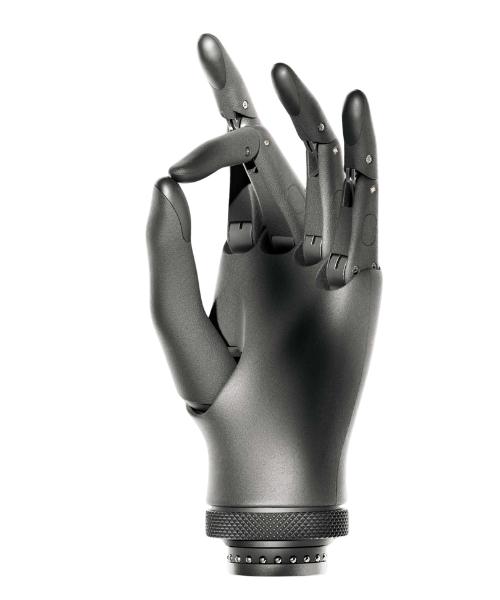
Key Capabilities of Esper Hand

  • intelligent muscle signal recognition
  • AI-powered user adaptation
  • self-learning based on everyday actions
  • natural control without complex combinations
  • multiple grip types (pinch, power, cylindrical, etc.)
  • high response speed

Everyday Functionality

Esper Hand allows a wide range of tasks to be performed:

  • using a smartphone
  • holding and carrying objects
  • typing and working at a computer
  • cooking
  • performing household and professional tasks
  • working with small objects

Advantages of Esper Hand

  • high movement precision
  • minimal adaptation time
  • personalization to lifestyle
  • ease of control
  • reduced muscle strain
  • gradual improvement of control

Adaptation and Training

One of the key features of Esper Hand is its ability to learn.

The prosthesis:

  • memorizes frequently used movements
  • optimizes control
  • reduces errors
  • makes movements more natural

This significantly accelerates the adaptation process compared to classic prostheses.

Cost of a Hand Prosthesis in Ukraine

The cost depends on the type of prosthesis and its functionality.

  • mechanical hand prostheses — approximately from UAH 30,000 to 150,000
  • bionic hand prostheses — approximately from UAH 250,000 to 1,200,000 and above


The price includes:

  • consultation
  • solution selection
  • fabrication
  • configuration
  • training
  • rehabilitation

In Ukraine, a hand prosthesis may be provided free of charge under the state program with valid medical indications and an IPR (Individual Rehabilitation Program).

Free Hand Prosthetics

Hand prosthetics in Ukraine may be provided free of charge under the state program for supplying technical rehabilitation aids.

The program operates under Resolution No. 321 of the Cabinet of Ministers of Ukraine.

The “ZDOROVYE” Center provides a full cycle:

  • document processing
  • prosthesis fabrication
  • training
  • rehabilitation
  • ongoing support

What Is Included in Free Hand Prosthetics

Our center provides the following free of charge:

  • hand prosthesis fabrication
  • individual fitting
  • control configuration
  • usage training
  • rehabilitation
  • specialist support

Additionally:

  • free specialist home visit
  • transport to the center
  • accommodation and meals
  • assistance with document processing

Production Timelines

  • mechanical prostheses — up to 20 business days
  • bionic prostheses — up to 30 business days

Each stage includes fittings and adjustments.


How the Hand Prosthetics Process Works

1. Consultation
residual limb assessment

2. Solution Selection
choosing the prosthesis type

3. Fabrication
creating an individual socket

4. Configuration
adapting the control system

5. Training
mastering movements and skills

6. Service
maintenance and repair

Andriy — a serviceman who received a bionic arm prosthesis

Андрій — військовий, який отримав біонічний протез руки

FAQ

Can I fasten buttons and zippers with a hand prosthesis?
Yes, but it depends on the type of prosthesis. With bionic prostheses, such actions are possible after training. With mechanical ones — it is more challenging, but basic skills can also be mastered.


Can I write with a pen or type on a keyboard?
Yes. Bionic prostheses allow holding a pen and typing on a keyboard. Movement precision comes with practice.


Can I use a smartphone?
Yes. Modern bionic prostheses allow users to:

  • tap the screen
  • hold the phone
  • scroll through pages
  • type messages

Can I pick up small objects (coins, keys, cards)?
Yes, but it requires configuration and training. Bionic prostheses support pinch grip, which allows working with small objects.


Can I cook with a hand prosthesis?
Yes. After adaptation, patients can:

  • hold kitchen utensils
  • cut food (with caution)
  • perform basic kitchen tasks

Can I do physical work with a hand prosthesis?
Yes, but it is important to account for the load. Mechanical prostheses are more suitable for heavy work, while bionic ones are better for precision tasks.


How noticeable is the gripping force? Can I crush an object?
In the early stages — yes, errors are possible. But over time, the patient learns to control grip strength. In bionic prostheses, this is adjustable.


Can I do sports with a hand prosthesis?
Yes. Options include:

  • fitness
  • running
  • basic exercises

Specialized attachments may be used for active sports.


Can I drive a car with a hand prosthesis?
Yes, after adaptation. The key is confident prosthesis control and safety. In some cases, additional vehicle modifications may be needed.


How long does it take to learn to use a hand prosthesis?
Basic skills — 1–2 weeks.
Confident use — 1–3 months.
Fine motor skills develop gradually.


Can I change the grip type in a bionic prosthesis?
Yes. Modern models have several modes:

  • pinch
  • cylindrical
  • power

Switching is done via muscle signals or settings.


What happens if the prosthesis gets wet?
Mechanical prostheses are generally resistant to moisture.
Bionic ones require caution, as they contain electronics. Some models have protection, but this is determined on an individual basis.


Can I sleep with a hand prosthesis?
No, this is not recommended. The prosthesis is removed for rest to avoid pressure on the residual limb and to extend the device’s service life.


How do I care for a hand prosthesis?
It is necessary to:

  • regularly clean the socket
  • monitor skin condition
  • undergo routine maintenance
  • avoid overloading the prosthesis

What should I do if the prosthesis starts working poorly?
Contact the center. The following may be required:

  • system reconfiguration
  • component replacement
  • repair

Can I upgrade to a more advanced prosthesis later?
Yes. As needs change or new technologies emerge, the prosthesis can be updated.


Can I get a hand prosthesis free of charge in Ukraine?
Yes. Prosthetics are available under the state program with a valid IPR and medical indications.

Get a Consultation

If you or your loved ones need upper limb prosthetics — it is important to start with a professional assessment.
👉 Submit a request and receive a specialist consultation