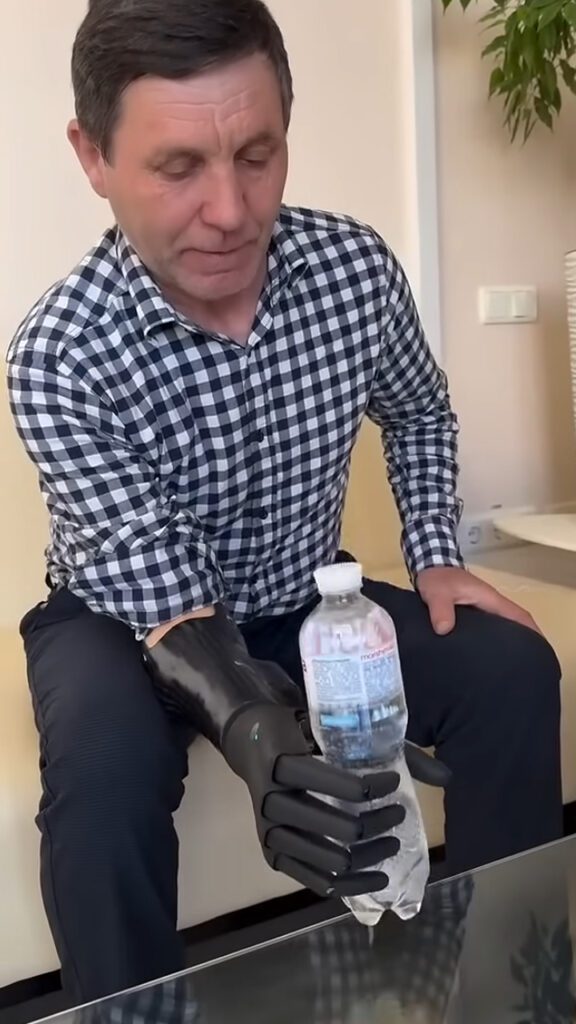
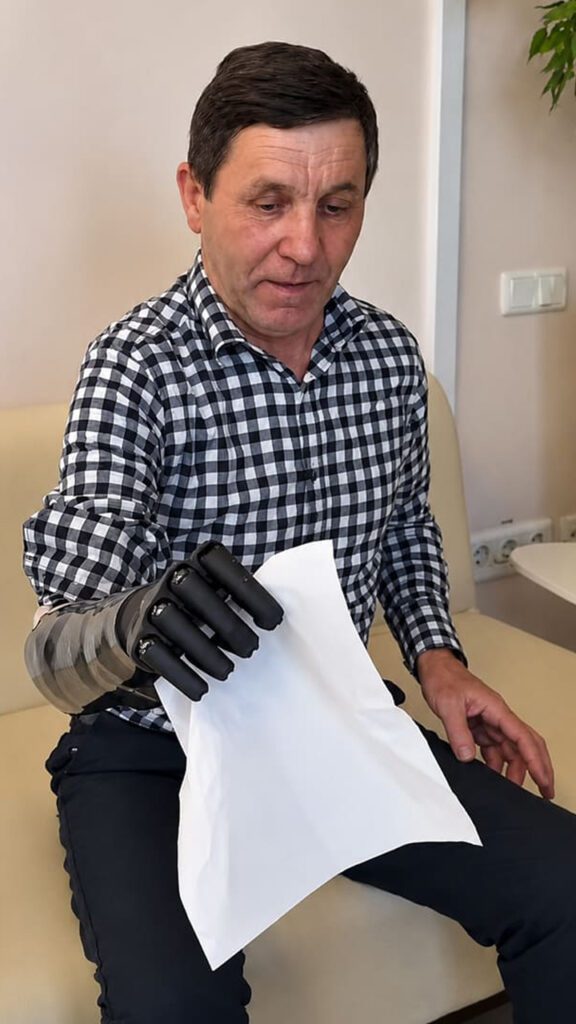
Forearm prosthesis

Types and Features

Forearm prosthesis (below the elbow) in Ukraine

Modern mechanical and bionic below-elbow arm prostheses — selection, fabrication, training, and support

Our centers are located in Kyiv, Odesa, and Rivne. We accept patients from all over Ukraine and provide comfortable conditions throughout the prosthetics process.

A forearm prosthesis is used following below-elbow arm amputation and helps restore essential hand functions: gripping, holding objects, performing everyday activities, and using a phone, tools, and other daily items.

The key advantage of forearm prosthetics is the preserved elbow joint. This makes it easier for the patient to control the prosthesis, movements become more natural, and the adaptation process is typically faster than with upper arm prosthetics.

In Ukraine, various solutions are available: cosmetic, mechanical, and bionic forearm prostheses. The prosthesis type is selected individually — taking into account the amputation level, residual limb condition, muscle activity, lifestyle, and the patient’s goals.

We support the patient at every stage: from the initial consultation and solution selection to prosthesis fabrication, usage training, rehabilitation, and ongoing maintenance.


When Is Forearm Prosthetics Recommended

Forearm prosthetics is recommended for patients with:

  • below-elbow arm amputation due to trauma, road accidents, or workplace injuries
  • consequences of combat operations and mine-blast injuries
  • congenital absence of part of the upper limb
  • severe medical conditions, including oncological and vascular pathologies
  • inability to restore arm function through surgical or other methods

A below-elbow arm prosthesis is selected after a specialist examination, residual limb assessment, and determination of the patient’s functional goals.


Amputation Levels in Forearm Prosthetics

The type of prosthesis depends on how much of the forearm is preserved and how active the residual limb muscles are.

Main levels:

  • below-elbow forearm amputation
  • transradial amputation
  • high forearm amputation
  • partial hand amputation with preserved forearm segment

The greater the preserved forearm length and muscle activity, the more options exist for precise prosthesis control. This is especially important when fitting a bionic prosthesis, which reads muscle signals.


Features of Forearm Prosthetics

Forearm prosthetics has its own important advantages and technical characteristics.

The key difference from an upper arm prosthesis is the preserved elbow. The patient does not need to control an artificial elbow module, so the prosthesis focuses primarily on restoring hand function and grip.

Key features of a forearm prosthesis:

  • natural elbow joint movement is preserved
  • prosthesis control is generally easier and faster to learn
  • lighter construction than an upper arm prosthesis
  • greater movement precision in daily activities
  • more capability for working with small objects
  • faster initial adaptation

At the same time, the quality of prosthetics depends on the precision of socket fabrication, skin condition, residual limb shape, and correct control configuration.


Why a Forearm Prosthesis Is Often More Functional

With a below-elbow amputation, the natural mobility of the arm at the elbow joint is preserved. This gives the patient greater control in everyday activities.

A forearm prosthesis helps restore:

  • opening and closing of the hand
  • gripping objects
  • holding a phone, cup, spoon, or pen
  • working with household objects
  • performing work and domestic tasks

This is why forearm prostheses often yield good functional outcomes when properly selected and combined with regular training.


How a Forearm Prosthesis Works

The operating principle depends on the chosen prosthesis type.

Mechanical Forearm Prostheses

A mechanical prosthesis operates through body movements and a cable system. The patient performs a specific movement with the shoulder, torso, or preserved part of the arm, which activates the hand opening or closing mechanism.

Advantages of a mechanical prosthesis:

  • reliability
  • ease of use
  • no electronics
  • less dependence on charging and batteries
  • ability to perform basic tasks

This option is suitable for patients who need a simple, durable, and straightforward solution for daily use.

Bionic Forearm Prostheses

A bionic forearm prosthesis works by reading muscle signals. Sensors detect muscle contractions in the residual limb, and the system then converts these signals into hand movement.

A bionic prosthesis allows:

  • opening and closing the hand
  • using different grip types
  • holding objects more precisely
  • working with small objects
  • performing more complex everyday actions

This prosthesis requires configuration, training, and regular practice, but offers a wider range of functionality.


Types of Forearm Prostheses

The prosthesis type is selected individually after consultation and assessment.

1. Cosmetic Forearm Prostheses

A cosmetic prosthesis is intended primarily to restore the appearance of the arm.

Features:

  • mimics the shape of the arm
  • does not perform active movements
  • helps restore body symmetry
  • may be used for psychological comfort

This option is suitable for patients who prioritize appearance and a natural visual look.

2. Mechanical Forearm Prostheses

A mechanical forearm prosthesis is used to perform basic functions.

Features:

  • operates without electronics
  • controlled via a cable mechanism
  • enables gripping and holding
  • noted for reliability and durability
  • suitable for everyday activity

Mechanical prostheses are often chosen for their simplicity, load resistance, and intuitive control.

3. Bionic Forearm Prostheses

A bionic forearm prosthesis is a more technologically advanced solution controlled by muscle signals.

Features:

  • myoelectric control
  • multiple grip types
  • precise hand movements
  • ability to work with objects of different sizes
  • adaptation to the patient’s habits

This prosthesis is suitable for patients who want to restore the maximum possible arm functionality.


Adapting to a Forearm Prosthesis

Adaptation is gradual. Even if the prosthesis is well matched, the patient needs time to get used to the new movements and learn to use the device with confidence.

Approximate timelines:

  • first control skills — 1–2 weeks
  • basic adaptation — 3–6 weeks
  • confident use — 2–3 months

Timelines depend on:

  • amputation level
  • residual limb condition
  • prosthesis type
  • muscle activity
  • regularity of practice sessions
  • individual patient characteristics

With bionic prosthetics, training is especially important, as the patient learns to control the prosthesis through muscle signals.


What You Can Do with a Forearm Prosthesis

After selection, configuration, and training, the patient can perform many everyday activities.

With a forearm prosthesis, you can:

  • hold a cup, spoon, or bottle
  • use a phone
  • open doors
  • get dressed
  • prepare simple meals
  • work at a computer
  • perform household tasks
  • hold small objects
  • return to work and an active life

Functionality depends on the prosthesis type. Bionic models offer more options for precise movements, while mechanical ones are well suited for basic and reliable tasks.


What to Consider Before Prosthetics

Before the prosthesis is fabricated, it is important to properly assess the residual limb condition and the patient’s goals.

Key factors:

  • residual limb length
  • residual limb shape
  • skin condition
  • presence of scars
  • muscle activity
  • tissue sensitivity
  • level of pain or discomfort
  • the patient’s household and professional needs

The more accurate the assessment, the more comfortable the prosthesis will be and the faster adaptation will proceed.


Possible Challenges When Using a Prosthesis

In the first weeks, the patient may encounter temporary difficulties. This is a normal part of the adjustment process.

Possible challenges:

  • chafing or pressure in the socket area
  • muscle fatigue
  • unfamiliar sensations when operating the prosthesis
  • difficulty with precise gripping
  • phantom pain
  • need for reconfiguration

Most of these issues are resolved through socket adjustment, prosthesis reconfiguration, and work with a rehabilitation specialist.


The Impact of Residual Limb Condition on Prosthetic Outcomes

The residual limb condition directly affects the comfort and effectiveness of the prosthesis.

Key factors:

  • residual limb shape
  • length of the preserved forearm
  • skin condition
  • muscle activity
  • absence of inflammation and significant pain
  • ability to achieve stable socket fixation

Before starting prosthetics, a specialist assesses the residual limb and determines which prosthesis type will be optimal.


Bionic Forearm Prostheses

Bionic forearm prostheses significantly expand arm functionality after a below-elbow amputation.

Esper Hand capabilities:

  • reading muscle signals
  • hand control via EMG
  • user-specific adaptation
  • learning movements over time
  • multiple grip types
  • more natural control

Advantages of a bionic prosthesis:

  • high movement precision
  • ability to work with small objects
  • comfort in everyday tasks
  • personalization to the patient’s lifestyle
  • modern appearance

One of the modern solutions is the Esper Hand — a bionic arm prosthesis with an intelligent control system.

A bionic prosthesis requires training and regular practice, but when properly configured can significantly increase patient independence.


Cost of a Forearm Prosthesis in Ukraine

The cost of a forearm prosthesis depends on the construction type, amputation level, functionality, and chosen components.

Mechanical forearm prostheses are more affordable and suitable for basic tasks. Approximate cost — from UAH 50,000 to 180,000.

Bionic forearm prostheses are a more technologically advanced solution. They require individual configuration and training. Approximate cost — from UAH 300,000 to 1,500,000 and above.

The price includes not only the prosthesis itself, but also:

  • consultation
  • solution selection
  • individual socket fabrication
  • prosthesis configuration
  • usage training
  • rehabilitation
  • specialist support

In Ukraine, a forearm prosthesis may be provided free of charge under the state program with valid medical indications and an approved IPR.


Free Forearm Prosthetics in Ukraine

Forearm prosthetics, including below-elbow arm prosthetics, may be provided free of charge under the state program for supplying technical rehabilitation aids.

The program is implemented in accordance with Resolution No. 321 of the Cabinet of Ministers of Ukraine, dated 2012, and guarantees the right to free provision of prostheses when medical indications are present.

The All-Ukrainian Rehabilitation and Prosthetics Center “ZDOROVYE” participates in this program and provides a complete prosthetics cycle — from document processing to full patient adaptation.


What Is Included in Free Prosthetics

Our center provides not only the forearm prosthesis itself free of charge, but also a full package of services:

  • fabrication of mechanical and bionic forearm prostheses
  • individual fitting and configuration
  • rehabilitation
  • prosthesis usage training
  • specialist support at every stage

Additionally for patients:

  • free specialist home visit
  • or free transport to the center
  • free accommodation and meals during the prosthetics period
  • assistance with all document processing

Forearm Prosthesis Production Timelines

Production time depends on the complexity of the construction and the chosen prosthesis type.

  • mechanical forearm prostheses — up to 20 business days
  • bionic forearm prostheses — up to 30 business days

Throughout the process, fittings, adjustments, and configuration are performed to ensure the prosthesis is comfortable, securely fitted, and meets the patient’s needs.


Important When Processing Documents

When obtaining a referral from the social protection authorities, it is necessary to specify our center:

LLC “All-Ukrainian Rehabilitation and Prosthetics Center ZDOROVYE” as the enterprise where prosthetics will be performed.

This is important because the selected enterprise is recorded in the documents and affects the ability to receive prosthetics specifically at our center.


When You Can Receive a Forearm Prosthesis Free of Charge

A patient is entitled to free forearm prosthetics when medical indications and the required documents are in place.

Grounds:

  • disability status or medical indications
  • Medical Advisory Committee / MSEK conclusion
  • approved Individual Rehabilitation Program (IPR)

Important:

  • the patient independently chooses the prosthetics provider
  • the selected center is indicated in the referral
  • the state compensates the prosthesis cost within the established budget

Who Is Eligible for Free Prosthetics

The following can receive a free forearm prosthesis:

  • citizens with disabilities
  • military personnel and veterans
  • those injured as a result of combat operations
  • patients after below-elbow arm amputation
  • patients after amputation for medical reasons

Important: rehabilitation for military personnel and veterans is carried out at the Rivne Regional Hospital for War Veterans.


How the Forearm Prosthetics Process Works

Prosthetics is carried out in stages to identify a comfortable, functional, and safe solution.

1. Consultation

At the first stage, the specialist assesses:

  • residual limb condition
  • amputation level
  • skin and tissue condition
  • muscle activity
  • the patient’s goals

After the consultation, the most suitable prosthesis type is determined: cosmetic, mechanical, or bionic.

2. Prosthesis Selection

Selection is performed on an individual basis.

Factors considered:

  • patient’s lifestyle
  • level of physical activity
  • household tasks
  • professional needs
  • need for precise gripping
  • suitability for bionic control

3. Fabrication

At the fabrication stage, an individual socket is created and components are selected.

It is important that the socket:

  • fits securely
  • does not chafe
  • does not cause pain
  • ensures correct prosthesis positioning
  • allows comfortable daily use

4. Configuration

After fabrication, the prosthesis is configured.

For a mechanical prosthesis, the cable system and ease of control are adjusted.


For a bionic prosthesis, sensors are configured, muscle signals are calibrated, and optimal control modes are selected.


5. Rehabilitation and Training

The patient learns to:

  • put on and take off the prosthesis
  • control the hand
  • grip objects
  • use the prosthesis in everyday situations
  • perform daily activities
  • gradually increase activity

Training helps make prosthesis use more confident and natural.


6. Service and Support

After the prosthesis is issued, the patient receives ongoing support.

When needed, the following are provided:
  • socket adjustment
  • reconfiguration
  • repair
  • component replacement
  • specialist consultation
  • scheduled maintenance

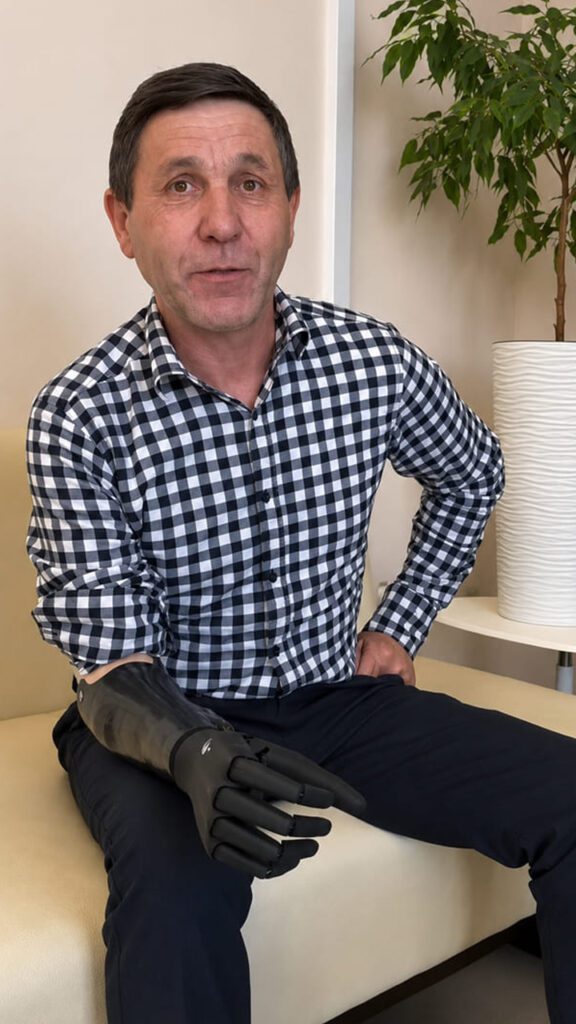
Andriy — a serviceman who received a bionic arm prosthesis

Андрій — військовий, який отримав біонічний протез руки

FAQ

When can forearm prosthetics begin after amputation?
Prosthetics begins after the residual limb has fully healed and the physician has given approval. This is usually possible after 3–6 weeks, but the exact timing depends on tissue condition, presence of swelling, scars, and the patient’s overall health.


How does a forearm prosthesis differ from an upper arm prosthesis?
With a forearm prosthesis, the elbow joint is preserved. This makes control easier, movements more natural, and adaptation faster. An upper arm prosthesis must replace both the elbow and the hand, making it more complex.


How does a mechanical forearm prosthesis work?
A mechanical prosthesis is controlled through a cable system. Movement of the shoulder, torso, or preserved part of the arm transfers force to the hand mechanism, allowing the patient to open and close the grip.


How does a bionic forearm prosthesis work?
A bionic prosthesis reads muscle signals from the residual limb. When the patient contracts specific muscles, sensors transmit the signal to the control system, and the hand performs the desired movement.


Can the arm be fully restored after a below-elbow amputation?
Fully restoring the natural arm is not possible, but modern prostheses allow most everyday and work-related tasks to be performed. Particularly good results are achievable when the elbow is preserved and rehabilitation is carried out regularly.


Is controlling a forearm prosthesis difficult?
Forearm prosthesis control is generally mastered faster than upper arm prosthesis control. The preserved elbow helps make movements more natural, and the main training focuses on hand control and gripping.


How long does adaptation to a forearm prosthesis take?
Initial skills are developed within 1–2 weeks. Basic adaptation usually takes 3–6 weeks. Confident use may take up to 2–3 months, especially with a bionic prosthesis.


Can I work with a forearm prosthesis?
Yes. After adaptation, many patients return to work. Capabilities depend on the prosthesis type, profession, workload, and the tasks that need to be performed by hand.


Can I use a phone with a forearm prosthesis?
Yes. This is particularly convenient with bionic prostheses, which allow more precise holding of the phone and fine actions.


Can I write with a forearm prosthesis?
In some cases, yes. It depends on the prosthesis type, amputation level, the patient’s skills, and the time dedicated to training.


Can I cook and perform household tasks?
Yes. After training, the patient can perform many household activities: hold objects, open packaging, prepare simple meals, use dishes, and carry out daily tasks.


Can I get a forearm prosthesis free of charge?
Yes. In Ukraine, a forearm prosthesis may be provided free of charge under the state program with valid medical indications and an approved Individual Rehabilitation Program.


What is included in free forearm prosthetics?
Free prosthetics includes prosthesis fabrication, individual fitting, configuration, usage training, rehabilitation, and specialist support. Transport, accommodation, and meals during the prosthetics period may also be provided.


What should I do if the prosthesis chafes or causes discomfort?
You should contact the center for adjustment. Chafing or pressure in the first weeks may occur due to tissue adaptation, changes in residual limb volume, or the need for additional socket adjustment.


How long does a forearm prosthesis last?
Service life depends on the prosthesis type, workload, conditions of use, and regularity of maintenance. Bionic prostheses require more attentive servicing and configuration.


Is it necessary to come to the center for prosthetics?
Yes, a visit is required for the examination, fittings, configuration, and training. Free transport or a specialist home visit is available if needed.


Is accommodation available during the prosthetics period?
Yes. Free accommodation and meals are provided to patients during the prosthetics period.


Is rehabilitation provided after receiving the prosthesis?
Yes. Rehabilitation is a mandatory part of the process. The patient learns to use the prosthesis, perform household activities, and gradually return to their usual level of activity.


Can I do sports with a forearm prosthesis?
Yes, but the type of activity and workload are selected individually. The prosthesis type, residual limb condition, and specialist recommendations should all be taken into account.


Can I drive a car with a forearm prosthesis?
Yes, after adaptation and with a sufficient level of prosthesis control. Each case is assessed individually.


Can I upgrade to a more advanced prosthesis later?
Yes. As the residual limb condition, activity level, or patient needs change, replacement, upgrade, or selection of a different prosthesis type is possible.

Get a Consultation

If you or your loved ones need upper limb prosthetics — it is important to start with a professional assessment.
👉 Submit a request and receive a specialist consultation