
Prosthetic components
What is a prosthetic liner: types, functions, materials and how to choose one
How a liner works, how suspension systems differ, and what a prosthetist looks at when selecting one
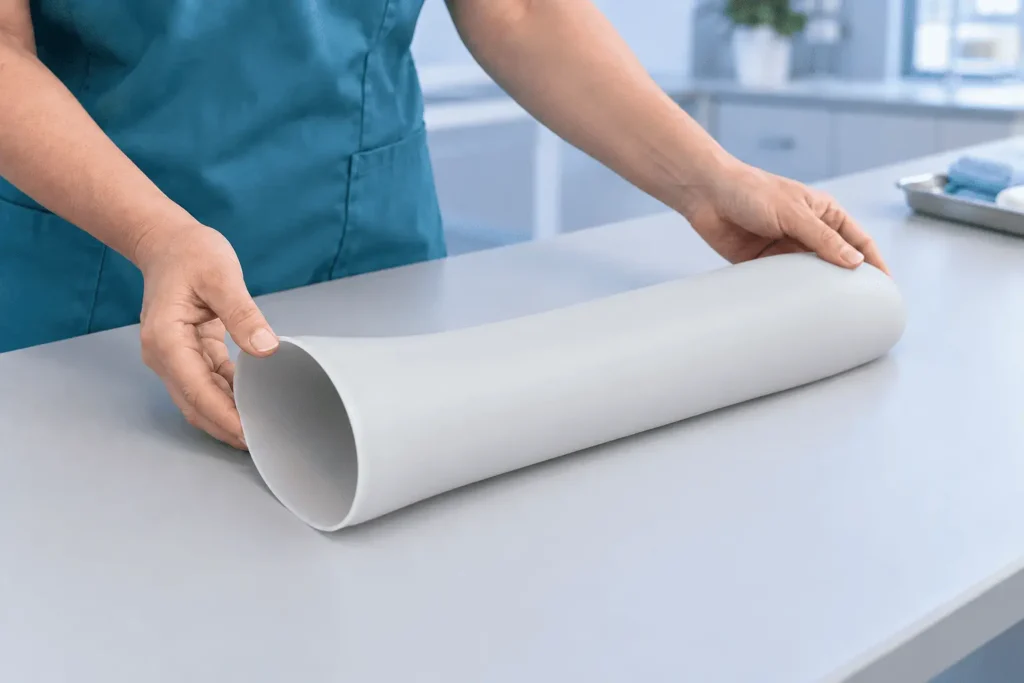
The liner is one of the most important elements of a modern limb prosthesis. It is rolled directly onto the residual limb and sits between the skin and the prosthetic socket.
Visually a liner may resemble a thick elastic stocking or a soft sleeve, but its functions go much further. A well-chosen liner helps to protect the skin, reduce friction and pressure and improve comfort while the prosthesis is worn, and in some systems it also holds the prosthesis on the limb.
The material, thickness, shape and suspension type of the liner largely determine how comfortable a person will feel in the prosthesis throughout the day.
What a prosthetic liner is
A prosthetic liner is a soft elastic interface that is put on the residual limb before the prosthesis is fitted.
It creates an intermediate layer between the skin of the residual limb and the inner surface of the socket.
The main tasks of a liner:
- protecting the skin;
- reducing friction;
- reducing shear forces;
- cushioning;
- distributing pressure;
- improving comfort;
- stabilising the soft tissues;
- reducing movement of the residual limb inside the socket;
- taking part in the suspension of the prosthesis.
This is why the choice of liner is considered together with the socket and the suspension system, rather than as a separate accessory purchase.
The liner creates a protective interface between the skin of the residual limb and the socket, and can serve both a cushioning and a suspension function at the same time.
Where the liner sits in the prosthesis
To understand its role, it helps to distinguish the main elements of a prosthetic system.
First the liner goes onto the residual limb.
After that the residual limb together with the liner is placed into the socket — the rigid part of the prosthesis, made to match the shape and features of the residual limb.
The remaining components are then attached to the socket. For a lower limb prosthesis these may be:
- the knee unit;
- the foot;
- adapters;
- connecting elements;
- the cosmetic cover.
Depending on the design, prosthetic socks, valves, sleeves, locks and vacuum systems may also be used between the liner, the residual limb and the socket.
Why a liner is needed
The skin of a residual limb is under far greater daily load than the skin of an intact limb.
Walking and movement produce:
- pressure;
- friction;
- stretching of the tissues;
- shear forces;
- exposure to sweat and increased humidity.
The liner helps to reduce the effect of these factors.
Skin protection
The soft material creates a barrier between the skin and the rigid socket.
This matters especially with:
- sensitive skin;
- bony prominences;
- postoperative scars;
- little soft tissue coverage;
- a high level of physical activity.
Cushioning
The liner partly absorbs the loads that arise during walking, standing or other activity.
Pressure distribution
A well-chosen liner helps to spread the forces acting on the residual limb over a larger area.
However, the liner alone cannot correct a poorly made socket. If the socket creates excessive pressure, chafes or fails to hold the residual limb properly, you need to see your prosthetist.
Soft tissue stabilisation
Some liner designs help to hold the soft tissues of the residual limb and reduce how much they move during activity.
This can improve control of the prosthesis.
Suspension of the prosthesis
In some systems the liner is part of the mechanism that keeps the prosthesis on the limb.
For example, a special pin can be attached to the distal end of the liner and clicks into a lock inside the socket.
Other systems rely on sealing and vacuum.
What liners are made of
Modern prosthetic liners are made from several types of elastic material.
The most common are:
- silicone;
- polyurethane;
- thermoplastic elastomers and various gel or copolymer materials.
Each option has its own characteristics.
No single material is the best one for every patient. A liner is selected individually.
Silicone liner
Silicone is one of the most widely used materials in modern prosthetics.
Silicone liners can provide:
- good adhesion to the skin;
- stability;
- cushioning;
- reduced shear forces;
- protection of scars and sensitive areas.
Silicone models come in different thicknesses, shapes and degrees of firmness. Some have an outer textile cover that makes them easier to use and more durable. There are also designs with extra soft zones over bony prominences. Silicone liners are often used both with mechanical locks and with vacuum systems.
Polyurethane liner
Polyurethane is known for the way it redistributes pressure and conforms to the surface of the residual limb.
Such liners may be considered for patients:
- with a sensitive residual limb;
- with bony prominences;
- with scarring;
- with areas that need extra pressure distribution.
Ottobock, for instance, describes its polyurethane liners as a material with good pressure-distribution properties that cushions sensitive and bony areas of the residual limb. Even so, the specific material should be chosen together with a prosthetist, taking the whole prosthetic design into account.
Gel and thermoplastic liners
Prosthetics also uses soft liners made of thermoplastic elastomers and various gel materials.
Their properties can differ depending on the manufacturer and the specific model.
Such products may differ in:
- softness;
- stretch;
- thickness;
- how well they conform to the shape of the residual limb;
- care requirements;
- the type of suspension.
So going by the name of the material alone is not the right approach. The specific model and its compatibility with the prosthetic system need to be assessed.
Types of liner by suspension method
Material is not the only difference between liners.
How the prosthesis is held on the residual limb matters just as much.
There are several common options.
Liner with a pin — Locking Liner
One of the best-known systems.
A special attachment is located at the distal — that is, the lower — end of the liner.
A metal or polymer pin is fixed to it.
When the person places the residual limb into the socket, the pin enters the locking mechanism inside it and is secured.
While donning the prosthesis, the person usually hears the lock click through successive positions.
To take the prosthesis off, the release button must be pressed.
Advantages of a pin system
This design can offer:
- straightforward mechanical suspension;
- a sense of secure connection between prosthesis and limb;
- relatively simple checking of the suspension;
- convenient donning for many users.
It does not suit every patient, however. The choice takes into account the shape and length of the residual limb, the condition of the soft tissues, skin sensitivity and other factors.
Cushion Liner — a liner without a distal lock
A cushion liner has no pin for mechanical suspension.
The liner itself primarily serves as a soft protective interface.
Other elements of the system may hold the prosthesis in place — for example an outer sealing sleeve.
It covers the area between the residual limb and the outside of the socket and helps to create a sealed space.
Such a system can work on the principle of negative pressure.
Seal-In — a liner with sealing rings
In designs of this kind, one or several sealing zones are located on the outer surface of the liner.
When the residual limb is placed into the socket, the seal makes contact with its walls.
Air is expelled from the space inside the socket, and air is prevented from flowing back in.
This creates the negative pressure that helps hold the prosthesis in place.
Locking, Cushion and Seal-In are among the common ways of arranging suspension with a liner.
Vacuum systems
A modern prosthesis can additionally be equipped with an active or elevated vacuum system.
A dedicated pump removes air from the space between the liner system and the socket.
This helps to reduce unwanted movement of the residual limb inside the socket and improves the stability of the suspension.
Vacuum system designs vary considerably, so the compatibility of the liner, socket, valves and other components is determined by the prosthetist.
Hybrid systems
Some systems combine several suspension methods.
A mechanical lock, for example, can be combined with vacuum suspension.
The aim of such designs is to bring together the advantages of different suspension principles.
How a liner differs from a socket
These two terms are often confused.
The liner is a soft elastic element worn directly on the residual limb.
The socket is the more rigid part of the prosthesis into which the residual limb, with the liner on, is inserted.
It is the socket that transfers body movement to the structure of the prosthesis and ensures correct load distribution.
The liner and the socket work together.
Even a very high-quality liner will not compensate for a badly made or poorly fitted socket.
How a liner differs from a prosthetic sock
Prosthetic socks and liners also serve different purposes.
The liner has a defined thickness and is in direct contact with the skin.
Prosthetic socks can be used to fine-tune the fit as the volume of the residual limb changes.
For example, if the volume of the residual limb decreases slightly over the course of the day, a specialist may recommend a sock of a particular thickness.
How socks are used, however, depends on the design of the specific prosthesis.
You should not add more of them on your own without understanding why the fit has become poor.
How a liner differs from a sleeve
A sleeve is an outer elastic cuff.
The liner sits between the skin and the socket, whereas the sleeve is usually worn on the outside of the socket, covering its rim and part of the limb.
In some vacuum systems the sleeve helps to create the seal.
In other words, these are two entirely different elements of the prosthetic system.
How a liner is selected
A liner cannot be chosen on the basis of shoe size or level of amputation alone.
The prosthetist assesses a whole set of parameters.
Size of the residual limb
The liner must fit snugly against the surface of the residual limb.
A liner that is too large may:
- shift;
- form wrinkles;
- weaken the suspension.
One that is too small can create excessive pressure and discomfort. Slipping may indicate a liner that is too large, while a pronounced feeling of tightness may indicate one that is too small.
Shape of the residual limb
A residual limb can have various shapes:
- cylindrical;
- conical;
- bulbous;
- irregular after trauma or several operations.
Manufacturers offer liners with different profiles, and with complex anatomy custom solutions can be used.
Length of the residual limb
The length of the residual limb determines whether certain suspension systems can be used, as well as the shape of the liner.
Condition of the skin
The following are always assessed:
- sensitivity;
- the condition of scars;
- skin folds;
- sweating;
- dryness of the skin;
- areas of chronic irritation;
- the condition of the soft tissues.
Bony prominences
Where bony areas are pronounced, extra cushioning or a particular distribution of material thickness may be required.
The person’s activity level
The requirements for a liner can differ considerably between someone who mostly moves around at home and a user who:
- walks a great deal;
- does physical work;
- plays sport;
- regularly covers long distances.
Fluctuations in residual limb volume
After an amputation the volume of the residual limb can change.
The changes are especially noticeable during the initial fitting period.
Tissue volume can also fluctuate over the course of a day.
These factors are always taken into account when choosing the liner and the socket design.
Hand strength and dexterity
This is an important factor too.
Some systems require more strength and dexterity to roll the liner on correctly or to secure the prosthesis.
The prosthetist therefore has to consider not only the state of the amputated limb but the patient’s overall functional abilities.
How to put a liner on correctly
The exact technique depends on the specific model, so the prosthetist’s instructions and the manufacturer’s guidance come first.
For most roll-on liners the principle is similar.
1Check the skin
Inspect the residual limb before putting the liner on.
There should be no:
- fresh injuries;
- marked irritation;
- blisters;
- open wounds.
The skin must be clean and dry.
2Turn the liner inside out
The liner is usually turned inside out almost down to its distal end.
3Place the distal end on the limb
The lower part of the liner is positioned directly against the end of the residual limb.
With a pin system, the pin must be aligned correctly with the axis of the limb.
4Roll the liner on
The liner is rolled gradually up the residual limb.
It should not simply be pulled up like an ordinary sock.
When done correctly you must avoid:
- wrinkles;
- air bubbles;
- twisting;
- displacement of the soft tissues.
It is rolling the liner on, not pulling it, that prosthetic manufacturers recommend.
Why there should be no wrinkles under the liner
Even a small fold of material can turn into an area of local pressure.
During walking that spot presses on the skin continuously.
This may result in:
- redness;
- chafing;
- tenderness;
- skin damage.
Before fitting the prosthesis, therefore, make sure the liner lies evenly.
Why air must not be left under the liner
If the liner is rolled on incorrectly, air pockets can remain between the skin and the material.
They can disrupt even contact and contribute to skin irritation.
If areas with trapped air are visible or noticeable after donning, the liner should be taken off and put back on as advised by the specialist.
How to care for a liner
Since the inner surface of the liner is in direct contact with skin and sweat for many hours, hygiene matters a great deal.
As a rule, the liner should be cleaned daily, or after each day of use, in line with the manufacturer’s instructions.
The general routine looks like this:
- Take the liner off.
- Turn it inside out.
- Rinse the inner surface with warm water.
- Use the recommended mild cleanser.
- Rinse off all traces of the cleanser.
- Dry the liner.
- Check it for damage.
Manufacturers recommend washing by hand and cleaning the liner thoroughly every day. The general rules of prosthesis care apply to its components too.
What a liner can be washed with
The cleanser depends on the material and on the manufacturer’s recommendations.
Commonly recommended:
- mild soap;
- a pH-neutral product;
- a dedicated prosthetic liner cleanser.
You should not use on your own:
- alcohol;
- harsh disinfectant solutions;
- solvents;
- heavily perfumed products;
- unknown chemical formulations.
Some substances can damage the material of a particular liner.
Alcohol, for example, can damage polyurethane products.
So follow the instructions for your specific model.
Can a liner be machine washed
As a rule, no.
Most modern liners are meant to be washed by hand.
Machine washing and drying can damage the material and change the properties of the product.
How to dry a liner
The liner must be completely dry before it is used again.
It is usually dried:
- naturally;
- at room temperature;
- on a dedicated stand, if the manufacturer supplies one.
It is not advisable to speed the process up with:
- a radiator;
- a heater;
- a hairdryer;
- intense direct sunlight.
High temperatures can damage the material.
Why have two liners
Some active users find it convenient to have a second liner.
While one is in use, the other can be:
- washed;
- dried completely;
- checked for damage.
This arrangement is especially handy when the prosthesis is worn for long hours every day.
Skin care with a liner
Even a perfectly chosen liner does not remove the need for daily skin care.
After taking the prosthesis off, inspect the residual limb.
Look out for:
- redness;
- blisters;
- abrasions;
- cracks;
- weeping areas;
- an unusual rash;
- painful spots;
- changes in skin colour;
- unpleasant odour;
- damage to the scar.
The residual limb should be washed regularly and dried thoroughly.
If a cream or other skin product is used, check with your prosthetist whether it is compatible with the liner material.
Greasy or unsuitable products can change how well the liner grips the skin, or affect the material itself.
Sweating under the liner
Sweating is one of the common problems with liner use.
The liner fits tightly against the skin, so moisture cannot evaporate freely.
The problem can be especially pronounced:
- in hot weather;
- during physical activity;
- in people who sweat heavily;
- when the prosthesis is worn for long uninterrupted periods.
Excess moisture can contribute to:
- softening of the skin;
- chafing;
- unpleasant odour;
- irritation.
If sweating is a persistent problem, discuss it with your prosthetist or doctor.
For some patients, different materials, designs or additional moisture-management measures may be considered.
Signs that a liner is not the right one
See your prosthetist if:
- the liner keeps sliding down;
- wrinkles form;
- it twists;
- excessive pressure appears;
- pain develops;
- the skin is chafed regularly;
- the prosthesis has started to hold less securely;
- the residual limb moves noticeably inside the socket;
- recurring skin damage has appeared.
The problem may not lie with the liner alone.
The cause may also be:
- a change in residual limb volume;
- a poorly fitting socket;
- a malfunctioning lock;
- a loss of seal;
- a damaged sleeve;
- wear of another element of the prosthetic system.
It is therefore better to assess the whole construction as a system.
When a liner needs replacing
A liner is a consumable part of the prosthetic system and wears out over time.
Its service life depends on:
- the material;
- the manufacturer;
- how intensively it is used;
- the person’s activity level;
- care;
- sweating;
- conditions of use;
- features of the residual limb.
Some manufacturers quote an approximate service life of around 6–12 months, but this is not a universal rule for every product.
A liner may need replacing sooner.
Signs of liner wear
Look out for:
- cracks;
- tears;
- thinning of the material;
- stretched areas;
- damage to the textile cover;
- a change in shape;
- weaker suspension;
- damage to the distal end;
- damage to the pin or its attachment;
- loss of the seal;
- new skin problems.
A worn liner should not be repaired at home with glue or anything else. It needs to be examined by a prosthetist.
Can a liner be trimmed at home
Not without a specialist’s advice.
Some models are indeed trimmed to length by the prosthetist to suit the patient’s anatomy.
Incorrect trimming, however, can:
- compromise the suspension;
- create pressure on the tissues;
- damage the material;
- change how the vacuum system works.
Reshaping the product is best left to a specialist.
Are there custom-made liners
Yes.
Alongside standard off-the-shelf models there are custom-made liners.
They can be used where the anatomy of the residual limb is complex, for example with:
- an irregular shape;
- pronounced bony prominences;
- complex scarring;
- a large difference in diameter between areas;
- a need for individual distribution of material thickness.
Custom models can have different thickness in different zones. The material may be thicker over the end of the residual limb and thinner near the joint to preserve mobility.
Are liners used only for leg prostheses
No.
Liners can be used in both lower and upper limb prosthetics.
The specific design, however, depends on:
- the level of amputation;
- the type of prosthesis;
- the suspension method;
- the anatomy of the residual limb;
- the user’s functional goals.
Liner systems of various kinds are used especially widely in lower limb prosthetics.
Which liner is best
There is no universal «best liner».
One patient does better with a silicone model and a pin lock, another with a soft liner and a vacuum system.
The choice has to take all of the following into account at once:
- the level of amputation;
- the length of the residual limb;
- the shape of the residual limb;
- the condition of the skin;
- scars;
- bony prominences;
- the amount of soft tissue;
- fluctuations in residual limb volume;
- physical activity;
- sweating;
- hand strength;
- the type of socket;
- the chosen suspension system;
- how the person feels in it.
The liner should therefore be selected by a specialist together with the other elements of the prosthetic system.
Frequently asked questions about prosthetic liners
Click a question to read the answer
Can a prosthesis be worn without a liner?
Some prosthetic designs can indeed use other kinds of interface between the residual limb and the socket.
So a liner is not a mandatory element of absolutely every prosthesis in existence.
In many modern systems, however, it plays an important role in comfort and suspension.
Which option suits a particular person is decided by the prosthetist.
Should a liner fit very tightly?
It should sit against the residual limb evenly and without wrinkles, but should not squeeze painfully.
If the liner causes pain, numbness or marked pressure, its size and fit need to be checked.
What should I do if air gets trapped under the liner?
It is better to take the liner off and roll it back on correctly.
Air pockets can create local problems with fit and with the skin.
What should I do if the liner keeps sliding down?
The cause may be the wrong size, a change in residual limb volume, wear of the product or other problems with the prosthetic system.
You should see your prosthetist.
Can cream be used under a liner?
That depends on the liner material and on the specific product.
Not all creams are compatible with prosthetic materials.
Anything applied immediately before donning the prosthesis should only be used in line with the manufacturer’s or prosthetist’s advice.
Does a liner need washing every day?
With daily use, most manufacturers recommend daily cleaning.
This removes sweat, skin oils and dirt and lowers the risk of skin irritation.
Can a liner be put on a damp residual limb?
As a rule, the skin should be clean and dry before donning.
Moisture can reduce grip and contribute to skin irritation.
What should I do if the prosthesis has started to chafe?
Do not try to put up with constant pain.
Take the prosthesis off, inspect the skin and see your prosthetist, especially if the problem keeps recurring.
The cause may lie with the liner, with a change in residual limb volume or with the fit of the socket.
Can I have several liners?
Yes. For someone who uses a prosthesis every day, having two suitable liners can be convenient for hygiene and drying.
They must, however, match the design of the specific prosthesis.
Key points about the prosthetic liner
A liner is not just a soft cover for the residual limb.
It is an important part of the prosthetic system and sits directly between the skin of the residual limb and the socket.
A well-chosen liner helps to:
- protect the skin;
- reduce friction and shear forces;
- distribute pressure;
- cushion the load;
- stabilise the soft tissues;
- improve comfort;
- take part in the suspension of the prosthesis.
Liners differ in material, thickness, shape and suspension method.
The most common are silicone, polyurethane and various gel or elastomer models.
In terms of suspension there are pin systems, Cushion, Seal-In, vacuum and combined options.
Which liner suits a particular patient is decided individually, after assessing the residual limb, the skin, the activity level and the design of the future prosthesis.
Choosing the liner and socket correctly is especially important: even advanced knee units, feet and electronic components will not deliver the comfort needed if the connection between the residual limb and the prosthesis is wrong.