
Partial foot amputation
Chopart amputation — key features, rehabilitation and foot prosthetics
What is preserved after surgery, why the biomechanics change, and which prosthesis restores roll-over
A Chopart amputation is one form of partial foot amputation in which the forefoot is removed while the calcaneus, the talus, the heel and the ankle joint are preserved.
The main advantage of this level is that it preserves as much limb length as possible along with the weight-bearing function of the heel. After surgery, however, the biomechanics of the foot change substantially: the forefoot lever is gone, muscle balance is disrupted, and the risk of equinus or equinovarus deformity increases.
Successful recovery after a Chopart amputation therefore depends on more than wound healing. Sound surgical technique, prevention of contractures, therapeutic exercise, care of the residual limb and an individually selected foot prosthesis all matter a great deal.
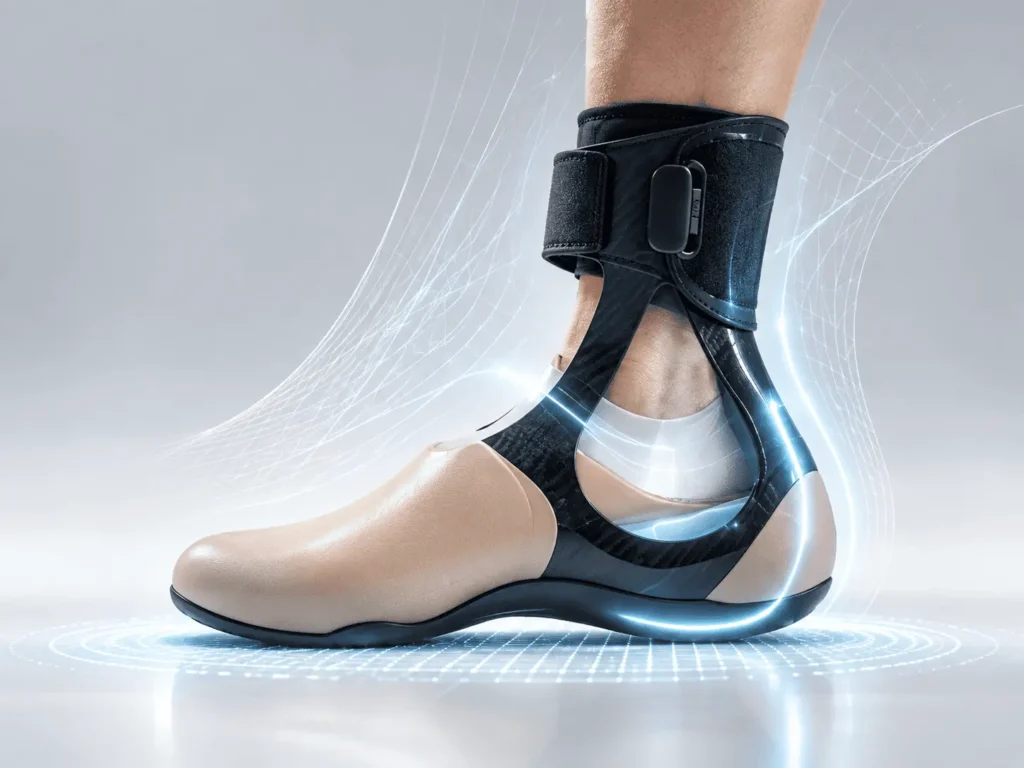
What a Chopart amputation is
A Chopart amputation is disarticulation of the foot at the transverse tarsal joint.
This joint is formed by two anatomical articulations:
- the talonavicular joint;
- the calcaneocuboid joint.
In a classic Chopart amputation the front part of the foot is removed, including the metatarsals and the more anterior tarsal bones.
Preserved are:
- the calcaneus;
- the talus;
- the heel region;
- the ankle joint;
- part of the limb’s natural weight-bearing surface.
The leg after such surgery therefore remains considerably longer than after a transtibial amputation.
A Chopart amputation belongs to the group of partial foot amputations.
Where the Chopart amputation line runs
The line of disarticulation passes through what is known as the Chopart joint — the transverse tarsal joint.
If the foot is thought of as divided into a hindfoot and a forefoot, what remains after surgery is the rear part of the foot together with the heel.
The structures lying in front of the talus and calcaneus are removed.
This is what fundamentally distinguishes a Chopart amputation from higher levels such as a transtibial amputation.
What remains after a Chopart amputation
After surgery the person retains:
- the talus;
- the calcaneus;
- the ankle joint;
- the heel and the heel fat pad;
- a significant part of the limb’s length.
Preserving the heel is functionally important, because it is a natural weight-bearing area.
In some cases, once fully recovered, a person can stand or move short distances without a full prosthesis, although the quality of gait is usually markedly different from normal.
A systematic review of outcomes of Chopart and Lisfranc amputations indicates that preserving this level can provide a functional residual limb, and that some patients are able to walk short distances without a prosthesis.
Why surgeons try to preserve the foot at the Chopart level
If the condition of the tissues and the blood supply allow a partial amputation instead of a higher one, there can be several advantages.
Limb length is preserved
The more of the person’s own limb that can be saved, the more natural anatomical structures remain.
With a Chopart amputation practically the whole length of the lower leg is preserved.
The ankle joint is preserved
This is one of the fundamental differences from a transtibial amputation.
Although the function of the ankle joint changes after surgery, the joint itself remains.
The heel is preserved
Where the tissues are in good condition, the heel continues to bear weight.
Short-distance support without a prosthesis may remain possible
This can be convenient in everyday situations, for example when transferring from a bed or moving a short distance.
Whether walking without a prosthesis is safe, however, is decided case by case.
When a Chopart amputation is performed
The reasons for a partial foot amputation vary.
Surgery may be considered in cases of:
- severe foot trauma;
- a crush injury of the forefoot;
- irreversible tissue damage;
- severe infection;
- osteomyelitis;
- tissue necrosis;
- impaired blood supply;
- complications of the diabetic foot;
- tumours;
- the consequences of blast injuries;
- gunshot wounds;
- frostbite.
The surgeon decides on the level of amputation individually.
The main goal is to remove non-viable tissue while, where it is safe to do so, preserving the most functional level of the limb.
How a Chopart amputation differs from a Lisfranc amputation
These operations are often confused, since both are partial foot amputations.
The level of removal, however, differs.
Lisfranc amputation
Performed at the level of the tarsometatarsal joints.
More of the foot is preserved.
Chopart amputation
Performed higher — through the transverse tarsal joint.
Mainly the talus and the calcaneus are preserved.
After a Chopart amputation the forefoot lever is therefore much shorter, and the problem of muscle imbalance is usually more pronounced.
The defining feature of a Chopart amputation — altered biomechanics
To understand the specifics of rehabilitation, it helps to know what happens once the forefoot is removed.
During normal walking the foot performs several tasks:
- accepts load on contact with the ground;
- stabilises the body;
- rolls over from heel to toe;
- creates a lever for push-off;
- helps carry the body forward.
After a Chopart amputation most of the forefoot lever is gone.
The person can still bear weight on the heel, but there is no longer a full natural roll-over across the front of the foot.
This is precisely why a correctly selected prosthesis or prosthetic-orthotic device matters so much for walking.
Why equinus deformity can develop after a Chopart amputation
One of the best-known problems at this level of amputation is equinus deformity.
Equinus means a position in which the foot points excessively downward — into plantar flexion.
The cause lies in altered muscle balance.
Once the forefoot is removed, some of the muscles and tendons that previously lifted and stabilised it lose their normal attachment point or mechanical advantage.
The Achilles tendon, meanwhile, keeps pulling on the hindfoot.
As a result, the force of plantar flexion may begin to dominate.
Over time this can leave the residual part of the foot fixed in plantar flexion.
Equinus and equinovarus deformity are among the best-documented functional problems following a classic Chopart amputation.
What equinovarus deformity is
Sometimes the foot does not only drop downward but also turns inward.
This position is called equinovarus.
It can lead to incorrect load distribution.
Instead of even support, pressure starts to concentrate on particular areas of the residual limb.
This raises the risk of:
- pain;
- chafing;
- callus formation;
- skin damage;
- overloading the edge of the residual limb;
- difficulties in fitting a prosthesis;
- gait disturbance.
Preventing deformity is therefore one of the most important tasks after surgery.
How surgeons can lower the risk of deformity
A modern Chopart amputation is not always limited to removing the damaged part of the foot.
Depending on the clinical situation, the surgeon may perform additional procedures to restore muscle balance.
These may include:
- Achilles tendon lengthening;
- tendon transfers;
- stabilisation of the hindfoot;
- other ways of balancing muscle forces.
In published clinical reports, Achilles tendon lengthening combined with tendon transfers helped keep the residual foot in a more neutral position and avoid pronounced equinus or varus deformity.
The specific surgical approach is decided by the orthopaedic trauma surgeon.
What the residual limb looks like after a Chopart amputation
A Chopart residual limb is very different from a transtibial one.
It is in effect a shortened residual foot with the heel and ankle joint preserved.
Once healing is complete, the specialist assesses:
- the length of the residual foot;
- the position of the heel;
- the condition of the skin;
- the condition of the postoperative scar;
- the presence of bony prominences;
- sensitivity;
- range of motion at the ankle;
- the presence of equinus;
- the presence of varus;
- the ability to bear load;
- the condition of the soft tissues.
The plantar skin is of particular importance, since it takes part in weight-bearing.
Healing after a Chopart amputation
Recovery time cannot be expressed as a single figure for all patients.
It depends on:
- the reason for the amputation;
- the nature of the injury;
- the state of the blood vessels;
- the presence of infection;
- diabetes;
- the condition of the soft tissues;
- the quality of the blood supply;
- the extent of surgery;
- co-existing conditions.
With traumatic amputations, recovery can follow a completely different course than after surgery performed because of vascular insufficiency or diabetic infection.
Loading of the limb is therefore increased only with the treating team’s approval.
Healing problems
Partial foot amputations preserve more limb length, but they require the remaining tissues to be in good condition.
Possible problems include:
- delayed wound healing;
- wound dehiscence;
- necrosis;
- infection;
- the need for repeat surgical debridement;
- revision amputation at a higher level.
In a systematic review of Lisfranc and Chopart outcomes, healing problems were fairly common, particularly after the traditional Chopart procedure. This underlines the importance of careful patient selection and assessment of tissue perfusion.
Rehabilitation after a Chopart amputation
Rehabilitation begins before the definitive prosthesis is made.
It is aimed at:
- tissue healing;
- swelling control;
- prevention of deformity;
- maintaining mobility;
- strengthening the muscles;
- restoring balance;
- preparing for walking;
- preparing the residual foot for prosthetic fitting.
The programme is drawn up individually by a physical and rehabilitation medicine physician together with other members of the team.
Stage one — protecting the surgical wound
In the early period the main task is safe healing.
Depending on the surgery, the following may be used:
- a postoperative dressing;
- an orthosis;
- a splint;
- immobilisation;
- offloading of the limb;
- special footwear options.
Do not start full weight-bearing on your own simply because the pain has eased. The permitted amount of loading is set by the surgeon.
Swelling control
Swelling after surgery is an expected tissue response.
As healing progresses it should gradually subside.
Methods of controlling it are chosen individually and may include:
- correct positioning of the limb;
- compression, once the doctor allows it;
- movement in the permitted joints;
- physical activity within the rehabilitation programme.
A significant sudden increase in swelling needs to be assessed by a specialist.
Maintaining ankle mobility
After a Chopart amputation the ankle joint is preserved.
One important task is therefore to keep as much functional mobility as possible and to prevent a fixed plantar-flexed position.
Once the doctor allows it, the programme may include exercises for:
- dorsiflexion;
- plantar flexion;
- control of the residual foot’s position;
- stretching of specific muscle groups.
Particular attention goes to preventing shortening of the Achilles tendon and the development of an equinus contracture. Aggressive stretching on your own soon after surgery is not acceptable.
Strengthening the muscles
Even when only part of the foot has been amputated, rehabilitation is not limited to that area.
Strengthening is needed for:
- the calf muscles;
- the thigh muscles;
- the gluteal muscles;
- the trunk muscles;
- the muscles of the sound limb.
Strong musculature helps to control body position and compensate for the altered biomechanics.
Balance training
With the forefoot gone, the area of natural support changes.
The person has to re-adapt their balance system.
Rehabilitation may include:
- weight shifting;
- exercises in standing;
- control of the centre of gravity;
- stability training;
- gradual loading of the prosthetic side.
All exercises are selected according to the stage of healing.
Gait training
Walking after a Chopart amputation differs considerably from normal walking.
The core problem is the absence of the natural forefoot lever.
Without a suitable prosthetic-orthotic solution a person may:
- shorten their step length;
- limp;
- avoid loading the limb;
- transfer weight to the other leg earlier;
- struggle with push-off.
A well-chosen prosthesis helps to restore part of the foot’s length and creates an artificial lever for roll-over and push-off. In one published clinical report, a foot prosthesis after a Chopart amputation improved push-off and gait quality.
Prosthetic fitting after a Chopart amputation
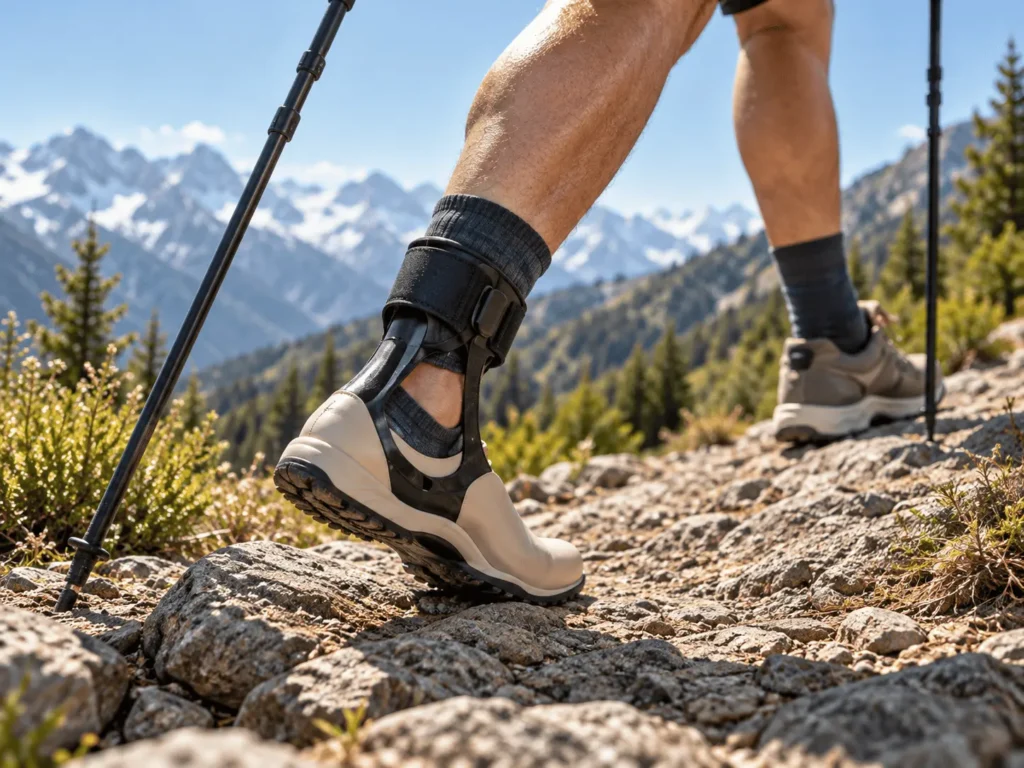
A Chopart prosthesis differs from a classic transtibial prosthesis.
Because the ankle joint, the heel and part of the foot are preserved, the device does not have to replace the whole lower part of the leg.
It has to compensate for the missing forefoot and restore the necessary elements of its biomechanics.
The main tasks of the prosthesis
A well-chosen design should help to:
- compensate for the lost foot length;
- improve stability;
- provide support;
- create a more natural roll-over;
- provide a lever for push-off;
- distribute load;
- protect the residual foot;
- hold the residual limb in a functional position;
- reduce the risk of excessive movement inside the socket;
- improve gait.
Where equinus deformity is present, the prosthesis must also account for the altered position of the residual foot.
Which prostheses are used after a Chopart amputation
There is no single design that suits every patient.
Various solutions are used.
Silicone foot prosthesis
It can enclose the residual part of the foot and fill in the missing forefoot.
Such a device can provide:
- skin protection;
- cosmetic restoration of the foot’s shape;
- better suspension;
- partial restoration of support.
Functional performance depends on the specific design.
Prosthesis with a functional foot element
For active patients the design may include a stiffer or energy-returning element that forms the forefoot lever.
It helps to produce a more effective roll-over.
Design with a carbon plate
Carbon elements can act as an artificial forefoot lever.
Depending on the design, the plate may run under the foot and assist push-off.
Prosthetic-orthotic device
In some cases higher fixation is needed, with elements enclosing the ankle or the lower leg.
Such systems may be used:
- with marked instability;
- with equinus deformity;
- with a complex residual limb shape;
- for additional control of movement.
The literature describes a range of options — from lightweight silicone and plastic partial foot prostheses to AFO-type designs and higher systems with a functional forefoot lever.
Why a shoe filler alone is sometimes not enough
At first glance it might seem enough simply to fill the empty front of the shoe with soft material.
But the problem with a Chopart amputation is not only the missing volume.
The front of a normal foot is a functional lever.
It takes part in:
- carrying the body forward;
- roll-over;
- stabilisation;
- push-off.
A simple soft filler can restore the shape of the shoe, but it cannot always replace these functions fully.
The prosthesis is therefore chosen on the basis of the individual patient’s activity and biomechanics.
Is special footwear needed
In many cases — yes.
Footwear is part of the overall prosthetic system.
Depending on the design, the following may be used:
- shoes with enough internal volume;
- a rigid sole;
- a rocker sole;
- shoes of a particular height;
- custom orthopaedic footwear.
Correctly chosen footwear lets the prosthetic design work the way the prosthetist intended.
Can you walk without a prosthesis after a Chopart amputation
Some patients, once fully healed, are able to stand and cover short distances bearing weight on the heel.
This is one of the advantages of preserving the heel region.
Being physically able to take a few steps, however, does not mean that walking without a prosthesis regularly is optimal.
Without the forefoot there is no normal lever for push-off, and load distribution changes.
Whether walking without a prosthesis is acceptable should therefore be discussed with the doctor and the prosthetist.
When prosthetic fitting can begin
There is no universal timeframe.
Specialists assess:
- the state of the wound;
- the condition of the skin;
- swelling;
- tenderness;
- the position of the foot;
- range of motion;
- the condition of the scar;
- the ability to bear load;
- the patient’s general condition.
In published studies, the timing of weight-bearing and prosthetic fabrication varied widely depending on the type of surgery and the patient’s condition. Going by someone else’s timeline — «after four weeks» or «after six» — is therefore the wrong approach.
Caring for a Chopart residual limb
Once the skin has healed completely, the condition of the residual foot must be checked every day.
Inspect especially carefully:
- the end of the residual limb;
- the heel;
- the edges of the scar;
- the outer and inner sides of the foot;
- bony prominences;
- the areas in contact with the prosthesis.
Look out for:
- redness;
- chafing;
- calluses;
- blisters;
- cracks;
- open sores;
- swelling;
- tenderness;
- changes in skin temperature.
Repeated damage to the same spot often points to a problem with load distribution or with the fit of the prosthesis.
Pain after a Chopart amputation
Pain can have various causes.
It may be related to:
- postoperative healing;
- the scar;
- tissue overload;
- a bony prominence;
- nerve irritation;
- a neuroma;
- deformity of the residual foot;
- a poorly fitting prosthesis;
- skin damage.
Phantom sensations and phantom pain in the missing part of the foot or in the toes are also possible after a partial amputation.
With new, increasing or persistent pain, the cause needs to be established rather than simply getting used to the discomfort.
Possible complications after a Chopart amputation
Possible problems include:
- delayed healing;
- infection;
- skin damage;
- chronic wounds;
- a painful scar;
- bony prominences;
- equinus contracture;
- equinovarus deformity;
- incorrect load distribution;
- pain;
- difficulty fitting a prosthesis;
- altered gait.
In individual cases with severe complications, further surgery may be needed.
But having an amputation at the Chopart level does not in itself mean a person will face all of these problems.
Much depends on the condition of the tissues, surgical technique, prevention of deformity, rehabilitation and a correctly selected prosthetic system.
Why the Chopart level is called difficult for prosthetic fitting
On one hand, the person keeps a lot of limb length and their own heel.
On the other, the residual foot is very short.
The prosthetist faces several tasks at once:
- accommodating a functional forefoot section;
- keeping acceptable leg length symmetry;
- providing secure suspension;
- controlling movement of the residual foot;
- not overloading sensitive areas;
- providing roll-over.
On top of that, the space available for prosthetic components is limited.
Making a good prosthesis after a Chopart amputation therefore calls for an individual approach.
Can a person return to an active life
In many cases — yes.
The outcome depends on:
- the reason for the amputation;
- the state of the blood vessels;
- the condition of the residual foot;
- the presence of deformity;
- general physical condition;
- the quality of rehabilitation;
- a correctly selected prosthesis;
- the person’s own motivation.
The medical literature describes patients who, after a Chopart amputation and prosthetic fitting, walked independently over significant distances and returned to a fairly high level of physical activity.
Frequently asked questions about Chopart amputation
Is a Chopart amputation an amputation of the foot or of the leg?
It is a partial foot amputation.
The lower leg and the ankle joint are preserved.
Which bones remain after the operation?
The main foot bones preserved are the talus and the calcaneus.
The heel is preserved as well.
Is the ankle joint preserved?
Yes.
This is one of the important advantages of this level of amputation.
Is the heel preserved?
In a classic Chopart amputation the heel is preserved.
That is exactly why the person retains a natural weight-bearing area.
Is a prosthesis needed after a Chopart amputation?
In most cases a prosthesis or a special prosthetic-orthotic device substantially improves function for everyday walking.
Some people can take short steps without one, but that does not replace the normal biomechanics of the foot.
Why can a Chopart residual limb point downward?
Most often this is due to disrupted muscle balance and the dominant pull of the Achilles tendon.
This is how equinus deformity develops.
Can equinus be corrected?
The approach depends on how severe it is and on whether the deformity is still flexible or already fixed.
Options may include:
- rehabilitation methods;
- orthotic management;
- changing the prosthetic design;
- surgical correction.
The decision is made by a specialist after examination.
Can ordinary shoes be worn?
That depends on the prosthesis.
Some modern designs fit into suitable off-the-shelf shoes; others require orthopaedic or specially selected footwear.
Is sport possible?
It depends on the condition of the residual limb, the activity level and the type of prosthesis.
With a good functional result, some patients return to a high level of physical activity.
How does a Chopart prosthesis differ from a transtibial one?
With a transtibial amputation a substantial part of the limb has to be replaced, including the function of the ankle and foot.
With a Chopart amputation the lower leg, the heel and the ankle joint are preserved.
The prosthesis therefore mainly compensates for the missing forefoot and restores its functional lever.
Key points about Chopart amputation
A Chopart amputation is a partial foot amputation through the transverse tarsal joint.
Preserved after surgery are:
- the heel;
- the calcaneus;
- the talus;
- the ankle joint;
- practically the whole length of the lower leg.
This preserves a natural weight-bearing surface and in some situations makes short-distance support without a prosthesis possible.
This level of amputation has its own characteristics, however.
Once the forefoot is removed, the natural push-off lever disappears and muscle balance changes. One of the main potential problems is the development of equinus or equinovarus deformity.
After the amputation, therefore, a great deal depends on:
- sound surgical shaping of the residual limb;
- preserving muscle balance;
- preventing contractures;
- restoring mobility;
- strengthening the muscles;
- monitoring the condition of the skin;
- gait training;
- an individually selected foot prosthesis.
Modern prosthetics makes it possible to create solutions that do more than fill the missing part of the foot — they help restore support, roll-over and a functional lever for walking.
So even a Chopart amputation, considered a technically demanding level for prosthetic fitting, can allow a person to return to an independent and active life when the overall approach is right.