Organising rehabilitation
What an individual rehabilitation programme is and why it matters
How the rehabilitation plan and the rehabilitation programme differ, who draws them up, and how they relate to getting a prosthesis
After an amputation, a severe injury, surgery or any other condition that has affected a person’s ability to move, care for themselves, work and carry out their usual daily activities, recovery should follow an individual programme.
Every patient starts from a different place: level of amputation, condition of the residual limb, physical fitness, co-existing conditions and personal goals all differ. One person needs to learn to walk independently again, another to prepare the residual limb for a first prosthesis, a third to master a bionic arm and return to work.
This is why the modern rehabilitation system uses an individual rehabilitation plan.
It is a document in which specialists set out the rehabilitation goals for a particular person, the measures needed and the order in which they should be carried out.
An important distinction: the plan and the programme are not the same thing
In everyday speech these two abbreviations are often mixed up.
The Ukrainian system has two related concepts:
- ІРП — the individual rehabilitation plan.
- ІПР — the individual rehabilitation programme.
The individual rehabilitation plan relates primarily to the organisation of rehabilitation care within healthcare. It is drawn up by a multidisciplinary rehabilitation team.
The individual rehabilitation programme is broader and can cover medical, social, vocational, educational and other forms of support.
The two documents can be linked: information and recommendations from the individual rehabilitation plan may be taken into account when the individual rehabilitation programme is drawn up.
What an individual rehabilitation plan is
An individual rehabilitation plan is a document developed for a specific patient on the basis of a rehabilitation assessment.
It sets out:
- the main goal of rehabilitation;
- specific objectives;
- the measures needed to reach those goals;
- indicative timeframes;
- the specialists required;
- the need for technical and other rehabilitation aids;
- whether further rehabilitation is needed.
Ukrainian legislation defines the individual rehabilitation plan as a document developed by a multidisciplinary rehabilitation team on the basis of the results of a person’s assessment, establishing the goals, objectives and the set of rehabilitation measures required.
What an individual rehabilitation plan is for
The main purpose of the document is to make rehabilitation a coherent process with clear goals rather than a set of separate procedures.
After a lower limb amputation, for example, it is not enough simply to make a prosthesis.
Before that it may be necessary to:
- achieve healing of the surgical wound;
- reduce swelling;
- shape the residual limb;
- maintain joint mobility;
- prevent contractures;
- strengthen the muscles;
- prepare the person for prosthetic fitting;
- select a prosthesis;
- teach them to put it on and take it off;
- restore balance;
- teach the person to stand and walk;
- gradually increase physical activity;
- prepare the patient for everyday, occupational and other demands.
All these stages are connected.
The individual rehabilitation plan helps the team of specialists understand what result is to be achieved and what actions are needed to get there.
Who draws up the individual rehabilitation plan
It is not written by a single doctor.
It is developed by a multidisciplinary rehabilitation team after assessing the person.
Depending on the patient’s condition, the team may include:
- a physical and rehabilitation medicine physician;
- a physical therapist;
- an occupational therapist;
- a speech and language therapist;
- a psychologist;
- a prosthetist-orthotist;
- a rehabilitation nurse;
- other specialists.
The composition of the team depends on the person’s specific needs.
The plan is agreed by the specialists after the rehabilitation assessment and approved by the physical and rehabilitation medicine physician.
Does the patient take part in drawing up the plan
Yes. This is one of the key principles of modern rehabilitation.
Specialists have to consider not only the person’s medical condition but their own goals.
After an amputation, for example, a person may want to:
- walk independently without walking aids;
- return to work;
- drive a car;
- play sport again;
- climb stairs unaided;
- care for a child;
- use public transport;
- return to military or professional duties;
- manage everyday tasks without help.
Rehabilitation is built not solely around the diagnosis but around restoring the person’s functioning.
For the rehabilitation team the question «What does the patient want to be able to do again?» is no less important than the diagnosis.
Who needs an individual rehabilitation plan
A plan can be drawn up for a person who already has limitations in daily functioning, or who is at risk of developing them.
This point matters: an officially confirmed disability status is not a prerequisite for having an individual rehabilitation plan.
It may be needed by patients:
- after limb amputation;
- after severe trauma;
- after a stroke;
- after spinal cord or brain injury;
- after complex orthopaedic surgery;
- after joint replacement;
- with nervous system disorders;
- with musculoskeletal disorders;
- after blast injury;
- after severe wounds;
- with other conditions that limit everyday activity.
The statutory definition covers people with limitations in daily functioning and those in whom such limitations may arise.
What the individual rehabilitation plan contains
The content depends on the condition and needs of the particular person.
A plan may include several main blocks.
The goal of rehabilitation
This is the result the person and the rehabilitation team want to achieve.
For example: to walk independently with a lower limb prosthesis indoors and outdoors.
Or: to master an upper limb prosthesis and manage basic everyday tasks unaided.
The goal has to relate to the person’s real functional needs.
Rehabilitation objectives
The overall goal is broken down into more specific objectives.
For example:
- reduce swelling of the residual limb;
- restore full knee extension;
- increase muscle strength;
- learn to transfer independently;
- maintain balance in standing;
- prepare the residual limb for prosthetic fitting;
- learn to use the prosthesis;
- learn to walk on level ground;
- master going up and down stairs.
Rehabilitation measures
For each objective the necessary actions are defined.
These may be:
- physical therapy;
- occupational therapy;
- exercise;
- balance training;
- gait training;
- prevention of contractures;
- care of the residual limb;
- desensitisation;
- training in everyday skills;
- psychological support;
- training in the use of a prosthesis or other rehabilitation aid.
Indicative timeframes
Indicative timeframes may be set for each goal.
Rehabilitation, however, is a dynamic process.
If the patient’s condition changes, goals and timeframes can be revised.
The specialists required
The plan specifies which specialists the person needs and to what extent.
The rehabilitation aids required
The need for assistive rehabilitation devices may be set out separately.
These include, among others:
- limb prostheses;
- orthoses;
- crutches;
- walking frames;
- wheelchairs;
- various mobility aids;
- self-care aids;
- other technical devices.
The Ukrainian rules on organising rehabilitation expressly provide that the plan may define the need for rehabilitation aids, including prostheses.
An individual rehabilitation plan after amputation
For someone who has had an amputation the plan matters especially, because prosthetic fitting is only one stage of recovery.
The rehabilitation pathway may look like this.
1The postoperative stage
At this stage the main tasks are:
- wound healing;
- pain control;
- prevention of complications;
- swelling control;
- correct positioning of the limb;
- maintaining joint movement.
2Preparing the residual limb
Once the specialists give the go-ahead, gradual preparation of the residual limb begins.
It may include:
- swelling control;
- compression therapy;
- shaping of the residual limb;
- skin care;
- scar work;
- desensitisation;
- prevention of contractures.
3General physical preparation
The whole body has to be prepared for using a prosthesis.
The programme may include:
- strengthening the muscles;
- building endurance;
- core training;
- developing balance;
- exercises to maintain mobility;
- practising safe transfers.
4Assessment before prosthetic fitting
Specialists assess:
- the condition of the residual limb;
- the skin;
- scars;
- the level of amputation;
- the length of the residual limb;
- joint mobility;
- muscle strength;
- balance;
- the person’s functional goals.
A suitable prosthetic system is chosen on the basis of this information.
5Prosthetic fitting
Once the prosthesis has been made, adjustment and adaptation begin.
The person is taught to:
- put the prosthesis on and take it off correctly;
- use the liner;
- monitor the condition of the skin;
- recognise a correct socket fit;
- use the suspension system;
- care for the prosthetic components.
6Training in the use of the prosthesis
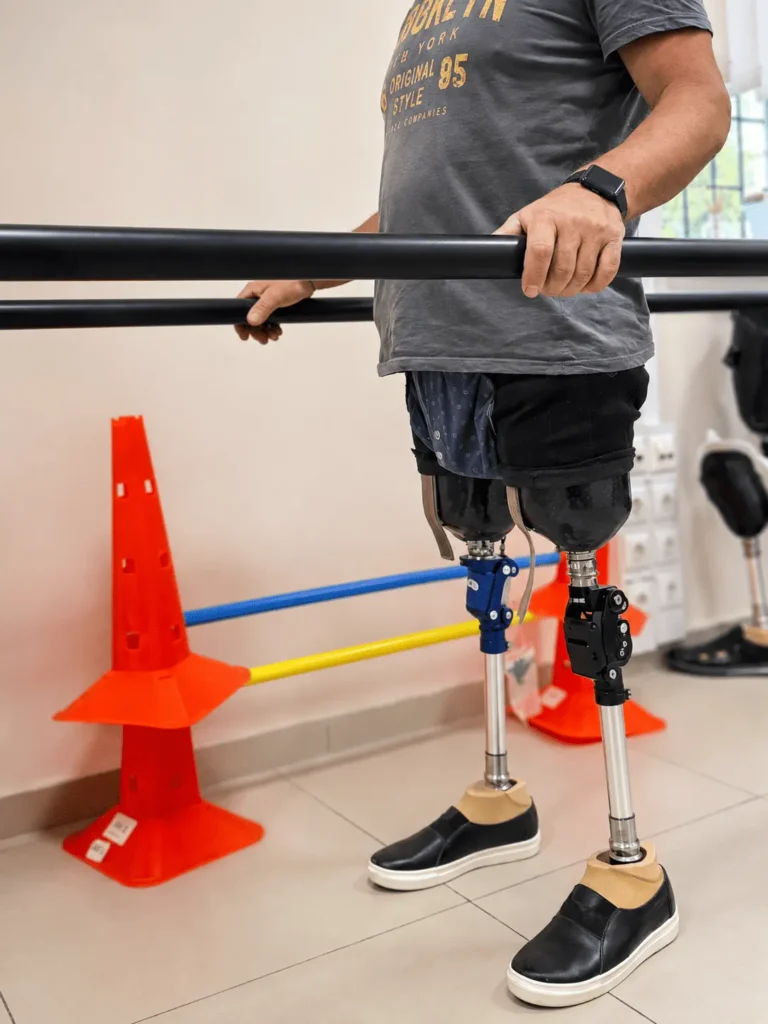
With a lower limb prosthesis the person gradually learns to:
- stand up;
- shift weight;
- keep balance;
- walk;
- change direction;
- sit down and get up;
- negotiate uneven ground;
- go up and down stairs.
With an upper limb prosthesis, training may cover:
- controlling the prosthesis;
- grasping objects;
- performing everyday tasks;
- working with both hands;
- mastering different grip patterns;
- using the prosthesis at work.
Which stages of rehabilitation the plan covers
The current rules on organising rehabilitation in Ukraine provide for three rehabilitation periods:
- acute;
- post-acute;
- long-term.
The individual rehabilitation plan has corresponding sections for these periods.
This means it is not limited to the time a person spends in hospital.
Rehabilitation can continue after discharge, during preparation for prosthetic fitting, after the prosthesis is received and later on as required.
Can the plan be changed
Yes.
It is not a document that is written once and never revisited.
A person’s condition changes.
After an amputation, for instance:
- swelling subsides;
- the volume of the residual limb changes;
- muscle strength increases;
- the person starts walking;
- the need for walking aids changes;
- new functional goals appear;
- the person receives a prosthesis;
- the level of activity rises.
Rehabilitation goals therefore have to be adjusted in line with the progress achieved.
Once one objective has been met, the team can move on to the next.
How the result of rehabilitation is measured
The result is not the number of massages, training sessions or procedures delivered.
The core question is: has it become easier for the person to do what they need to do?
For example:
- can they transfer independently;
- can they stand without support;
- has their walking distance increased;
- can they use the prosthesis;
- can they dress themselves;
- can they climb stairs;
- has their dependence on help from others decreased;
- can they return to work or study.
Modern rehabilitation focuses on how a person functions in real life.
What the individual rehabilitation programme is
The individual rehabilitation programme needs to be distinguished from the individual rehabilitation plan.
In the current Ukrainian system it is a personalised support programme that can span several areas:
- medical;
- physical;
- social;
- vocational;
- educational;
- other areas of rehabilitation.
Since 1 January 2025 Ukraine has used a new system for assessing everyday functioning in place of the former MSEK system. The medical part of the programme is based on the results of that assessment by an expert team.
What the programme can specify
The individual rehabilitation programme may contain recommendations on:
- prosthetic provision;
- orthotic provision;
- other assistive rehabilitation devices;
- medical devices;
- physical rehabilitation;
- psychological support;
- social services;
- vocational rehabilitation;
- education and training;
- workplace adaptation;
- other kinds of support the person needs.
The medical part includes, among other things, recommendations on providing the person with assistive rehabilitation devices.
How the plan and the programme relate to each other
Simplified, the difference can be pictured as follows.
The plan answers
«How will this person’s medical and physical rehabilitation proceed, and what goals need to be reached?»
The programme answers more broadly
«What comprehensive support does this person need, given their functional limitations?»
When drawing up the programme, the expert team has to take into account the recommendations and prescriptions contained in the individual rehabilitation plan, where such a plan exists.
For a person after an amputation, therefore, these documents do not compete — they can complement each other.
The rehabilitation plan and limb prosthetics
For a patient after an amputation, one of the most important questions is how the individual rehabilitation plan relates to getting a prosthesis.
The plan may define the person’s need for assistive rehabilitation devices, prostheses included.
Specialists can also record the patient’s functional needs and the characteristics to be taken into account in the prosthetic fitting that follows.
For example:
- activity level;
- walking ability;
- the need to manage stairs;
- occupational demands;
- everyday needs;
- the possibility of playing sport;
- the condition of the other limb;
- the need for additional rehabilitation aids.
This matters because the aim of modern prosthetics is not simply to replace a missing segment of a limb.
A prosthesis should help the person do precisely the things they need to do in daily life.
Do you need disability status to start rehabilitation after an amputation
No.
Medical rehabilitation and the drawing up of an individual rehabilitation plan should not wait until disability status has been granted.
A plan can be developed for a person with a limitation in daily functioning, or at risk of one.
This is especially important after an amputation.
Preparing the residual limb, preventing contractures, rebuilding muscle strength and physical therapy should begin as soon as it is medically possible, not once administrative procedures are complete.
Does everything in the plan have to be followed
Rehabilitation is built with the person’s participation.
The patient should understand:
- what goals have been set;
- why a particular measure is being carried out;
- what result the specialists are aiming for;
- what alternatives exist.
The person is a full participant in decision-making.
Rehabilitation should not run on the principle of «the specialist decided, the patient must comply».
Its effectiveness depends largely on the person and the rehabilitation team working together.
Can a person say they want to return to work or sport
Not only can they — it is important for the specialists to know.
The requirements for a lower limb prosthesis differ between someone who moves around mainly at home and someone who wants to:
- cover long distances;
- return to physical work;
- play sport;
- drive a car;
- use stairs constantly.
The same applies to upper limb prostheses.
For one person everyday functionality matters most; another needs precision of movement for their work.
Personal life goals should therefore be discussed at the rehabilitation planning stage.
What to do if the person’s needs have changed
Tell the rehabilitation team.
For example:
- recovery has gone faster than expected;
- a new problem has appeared;
- a contracture has developed;
- the condition of the residual limb has changed;
- the person has received a prosthesis;
- the prosthesis needs further adjustment;
- work demands have changed;
- the person wants to increase their level of physical activity.
The rehabilitation plan can be revised in the light of the current situation and goals.
Frequently asked questions about the individual rehabilitation plan
Click a question to read the answer
Are the rehabilitation plan and the rehabilitation programme the same document?
No.
The individual rehabilitation plan is developed by a multidisciplinary rehabilitation team as part of rehabilitation care.
The individual rehabilitation programme is broader in scope.
The two are connected but serve different purposes.
Who draws up the plan?
A multidisciplinary rehabilitation team, after assessing the patient.
It is approved by the physical and rehabilitation medicine physician.
Is a plan needed after an amputation?
Where comprehensive rehabilitation care is required, such a plan makes it possible to define the goals of recovery, the measures needed and the requirement for a prosthesis or other rehabilitation aids.
Can a plan be drawn up before disability status is granted?
Yes.
The individual rehabilitation plan is not limited to people who already have confirmed disability status.
Can a prosthesis be specified in the plan?
Yes.
The current rules allow the plan to define the need for assistive rehabilitation devices, including prostheses.
Can rehabilitation after receiving a prosthesis be included?
Yes.
Receiving a prosthesis is not the end of rehabilitation.
Afterwards a person usually needs training in using the prosthesis and further restoration of function.
Can the plan be changed?
Yes.
As the person’s condition changes and goals are met, the rehabilitation pathway can be adjusted.
Are the patient’s wishes taken into account?
Yes.
Modern rehabilitation is guided by the person’s own needs and functional goals.
Key points about the individual rehabilitation plan
An individual rehabilitation plan is a personal recovery pathway.
It is created not for a diagnosis but for a particular patient, with their abilities, limitations, needs and life goals.
After an amputation such a plan helps to organise, step by step:
- recovery after surgery;
- preparation of the residual limb;
- prevention of complications;
- physical rehabilitation;
- preparation for prosthetic fitting;
- selection of the necessary rehabilitation aids;
- training in the use of the prosthesis;
- restoration of walking or hand function;
- return to independent living.
It is also important to keep the terms straight.
ІРП is the individual rehabilitation plan.
ІПР is the individual rehabilitation programme.
They serve different purposes but can both be part of a single rehabilitation pathway.
The main aim of both is not paperwork, but the fullest possible restoration of a person’s independence, mobility and participation in everyday life.